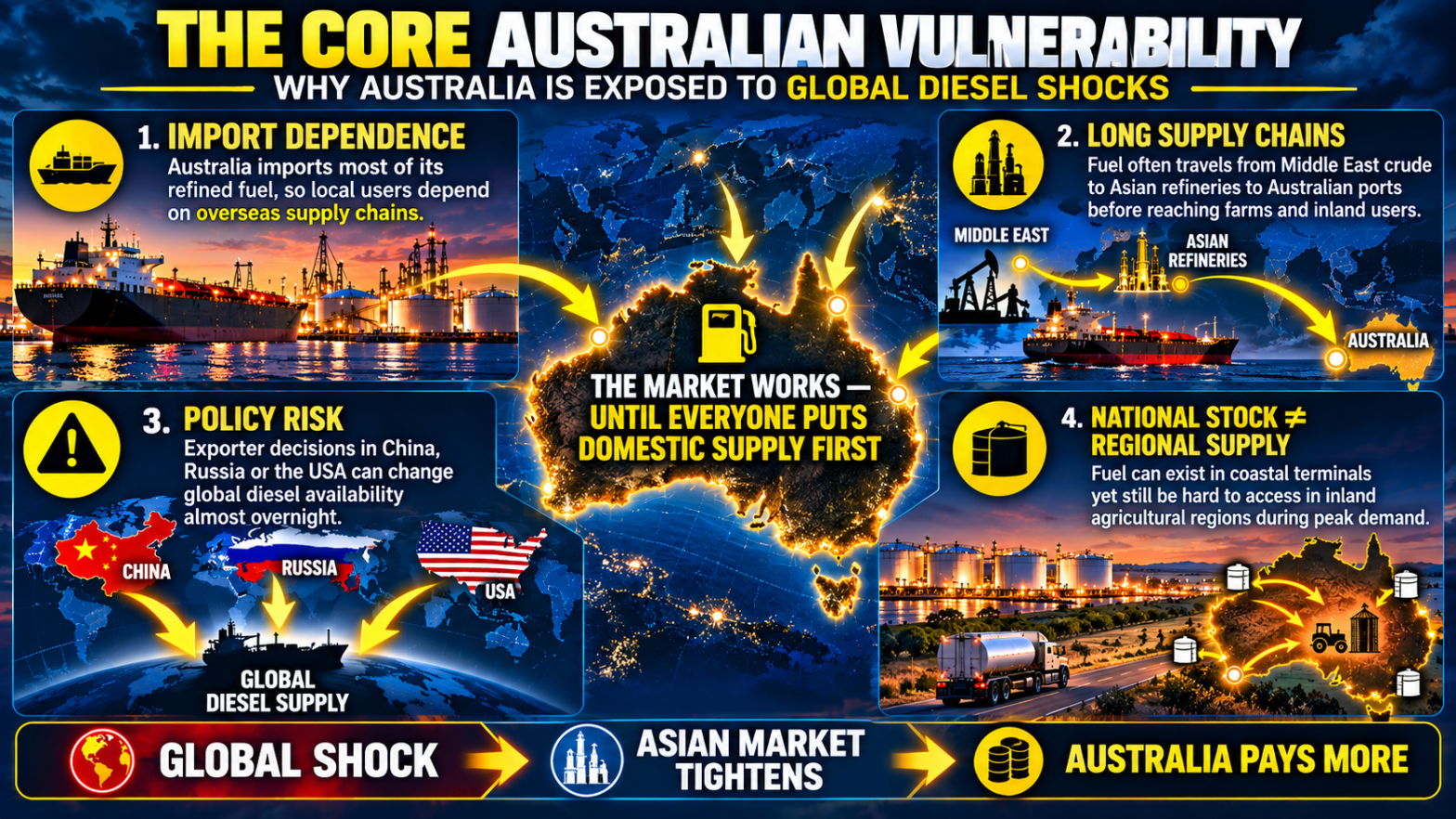
Australia is not currently running out of diesel. But the events of the past week have shown how quickly the global fuel market can change when major exporting countries decide domestic supply comes first.
China has suspended most refined-fuel exports for October while it rebuilds domestic inventories. Russia has extended restrictions on diesel exports through the end of October. For roughly 48 hours, the United States openly considered using a diesel export ban as leverage to push European countries into releasing emergency fuel stocks. The G7 then agreed to release 100 million barrels of diesel and other petroleum reserves, and President Donald Trump said on 2 October that the United States would not proceed with a diesel export ban.
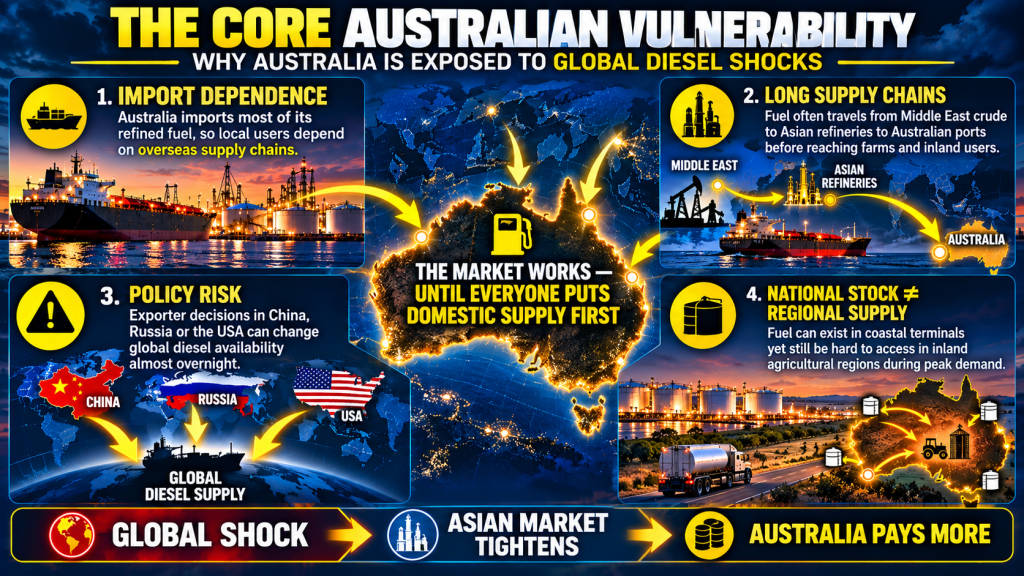
For Australia, that sequence is the real story. Fuel security is not simply a question of how many litres exist somewhere in the world. It is a question of whether the countries controlling those litres keep exporting, whether the refineries that supply Australia can access crude, whether shipping and insurance remain available, and whether fuel sitting at coastal terminals can physically reach farms and regional businesses when demand peaks.
The immediate position: Australia is exposed, but supplied
The latest Australian Government update, delivered on 3 October, reported 32 days of diesel cover, unchanged from the previous week. There were 50 fuel ships on their way to Australia and 3.6 billion litres of fuel contracted for delivery over the next four weeks, including 2.0 billion litres of diesel — the highest forward diesel orders since May.
| Australian fuel position — 3 Oct 2026 | Reported level |
| Diesel cover | 32 days |
| Petrol cover | 41 days |
| Jet fuel cover | 28 days |
| Fuel ships inbound | 50 |
| Total fuel contracted for next four weeks | 3.6 billion litres |
| Diesel contracted for next four weeks | 2.0 billion litres |
Those figures are reassuring, but they should not be interpreted as a countdown clock. Australia’s fuel-stock measures use different methodologies, imports continue to arrive and refinery crude and unfinished products can be counted differently depending on the measure. The government’s fuel-stock methodology explicitly warns that the measures are not directly comparable.
Where Australia actually gets its diesel
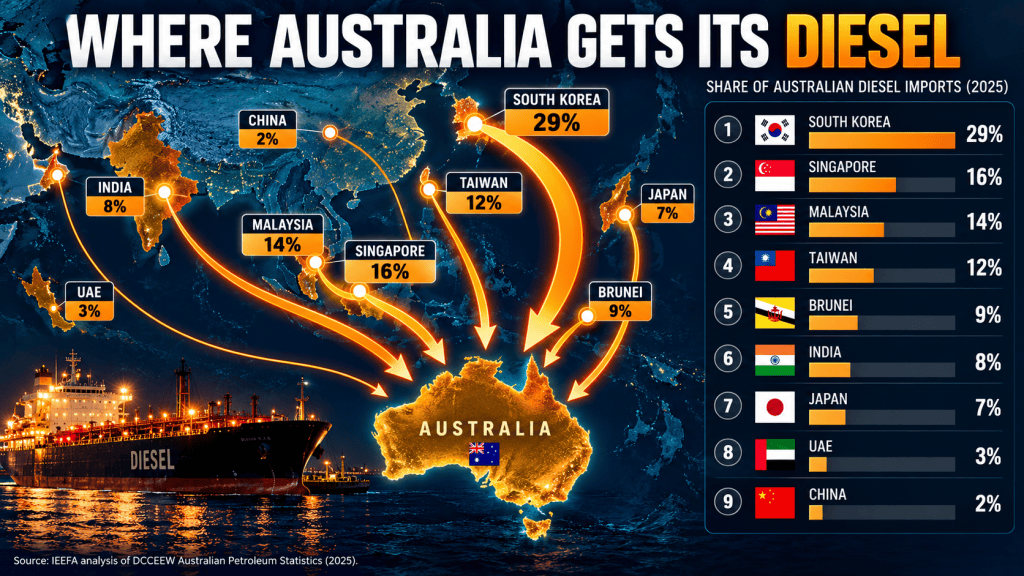
Australia is one of the world’s most import-dependent diesel markets. Independent analysis of Australian Petroleum Statistics estimates that about 87% of Australian diesel was imported in 2025, with only around 13% sourced from domestic production. The broader official energy statistics also show that imported refined products supply most Australian demand.
| Source country | Share of Australian diesel imports, 2025 |
| South Korea | 29% |
| Singapore | 16% |
| Malaysia | 14% |
| Taiwan | 12% |
| Brunei | 9% |
| India | 8% |
| Japan | 7% |
| United Arab Emirates | 3% |
| China | 2% |
At first glance, China’s 2% direct share might make its export suspension look unimportant to Australia. It is not. When Chinese cargoes disappear, Asian buyers do not disappear with them. They bid harder for Korean, Singaporean, Malaysian and Indian barrels — precisely the barrels Australia relies upon.
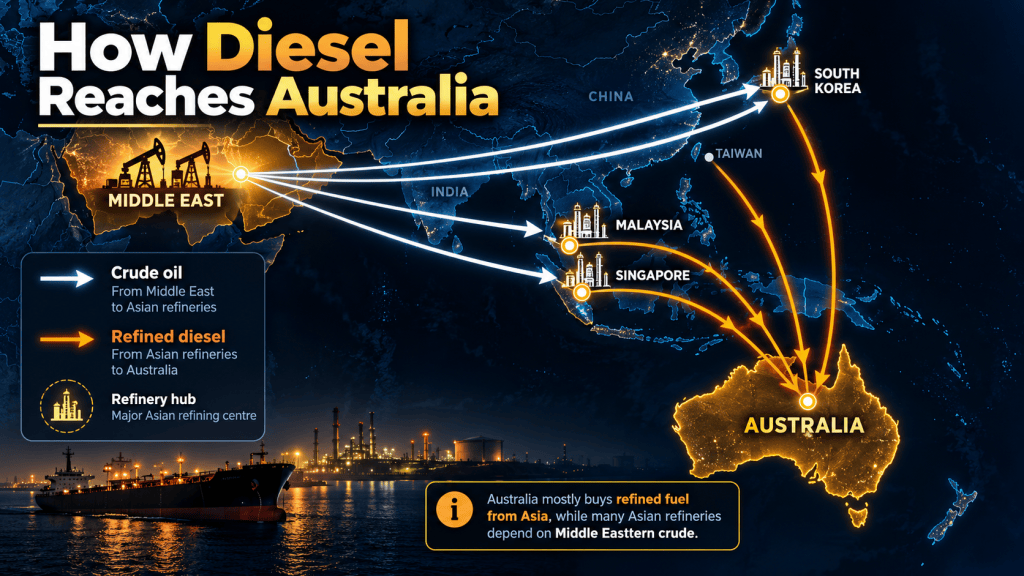
There is another layer. Many Asian refineries supplying Australia are heavily dependent on Middle Eastern crude. The Reserve Bank has noted that refineries cannot instantly switch between crude grades because plants are configured around particular feedstocks. Australia can therefore diversify its refinery supplier and still remain exposed to the same upstream crude route.
China: the first warning
China’s October action is better described as an export suspension than a permanent ban. Reuters reported on 1 October that Chinese refiners had suspended most fuel exports outside Hong Kong and Macau in order to rebuild domestic inventories. PetroChina cancelled cargoes and other refiners skipped scheduled exports. Further exports may resume if stocks improve.
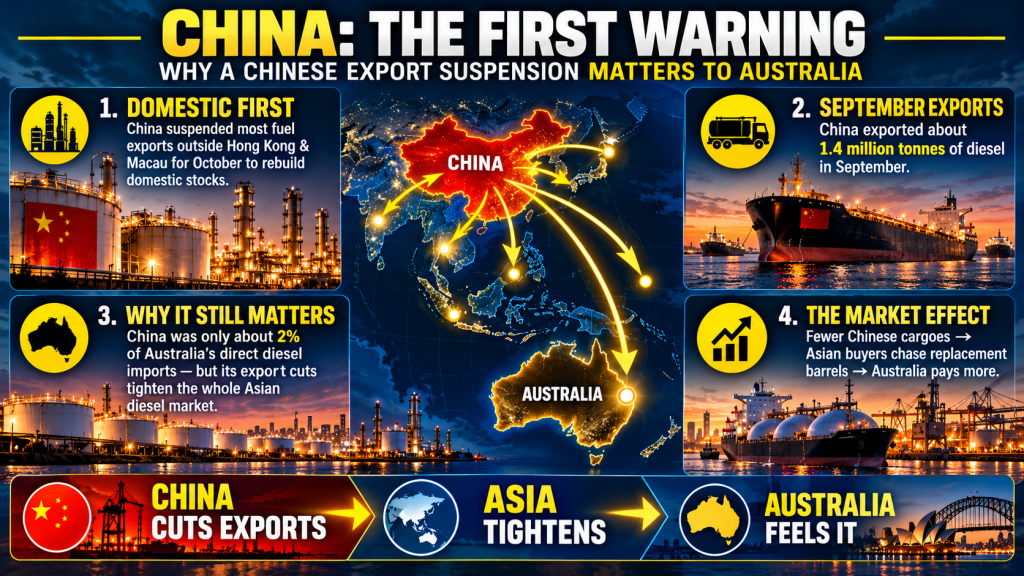
China had exported roughly 1.4 million tonnes of diesel in September. Removing that swing supply from Asia during a period when Russia and the Middle East are also constrained raises the clearing price for everyone.
The United States: why policy volatility matters
The United States matters differently. It is one of the largest diesel exporters in the world and, during the current disruption, an important source of replacement supply for Europe and Latin America. Australia does not need to import a US cargo directly to be affected by US policy: if US exports are restricted, European buyers simply turn toward India, the Middle East and Asia, increasing competition for the same pool available to Australia.
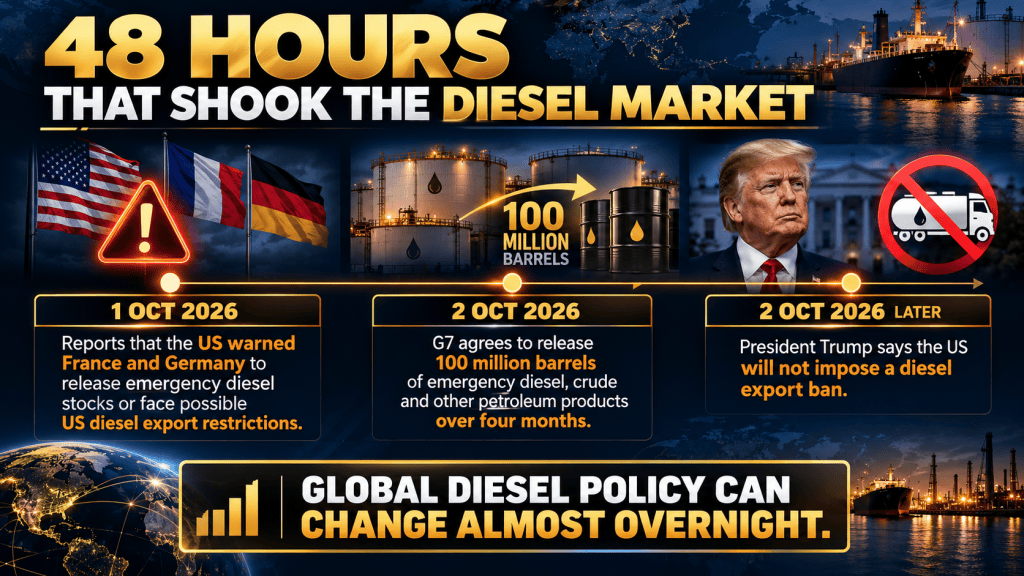
On 1 October, Reuters reported that the US administration had told France and Germany to release emergency diesel stocks or face the possibility of US export restrictions. On 2 October, the G7 agreed to a coordinated 100 million barrel release of diesel and other petroleum reserves through the International Energy Agency, front-loaded over the first 20 days. Later that day, President Trump said the United States would not proceed with a diesel export ban.
The risk for Australia is not that one particular country is uniquely unreliable. It is that energy policy becomes politically volatile when domestic fuel prices surge.
This is important because an exporter can make a completely rational domestic decision that has large external consequences. China prioritised its own inventories. Russia has restricted diesel exports while its refining system is under pressure. The United States considered an export restriction when record domestic prices became a political issue. None of these countries is required to prioritise Australian harvest demand over its own domestic market.
What happens if several suppliers pull back at once?
The current shock is unusual because several major sources of internationally traded diesel have been constrained at the same time:
| Supply centre | Current issue | Australian significance |
| China | October fuel-export suspension | Removes Asian swing supply |
| Russia | Diesel export restrictions extended through October | Removes supply from a historically major exporter |
| Middle East | Conflict and refinery/shipping disruption | Affects both refined products and crude feeding Asian refineries |
| United States | Export ban ruled out for now after being considered | Policy risk can redirect global trade quickly |
| South Korea / Singapore / Malaysia | Still supplying | Critical direct suppliers to Australia |
The immediate danger has eased because the US export-ban proposal was dropped and emergency stocks are being released. That does not mean the system is suddenly comfortable. China’s suspension and Russia’s restrictions remain active, and emergency stock releases are by definition a temporary bridge rather than new refining capacity.
National stocks are not the same as regional fuel security
This matters particularly to agriculture. Australia can have adequate national stocks while a farming district still experiences a shortage. Fuel has to move from coastal terminals through depots and distributors and then onto farm. During harvest, diesel demand is highly concentrated in both time and geography.
A litre at a coastal terminal is useful, but it is not the same as a litre in a farm tank before a three-day harvest window. Flooded roads, bridge restrictions, unavailable drivers, depot shortages or competing freight demand can all turn national inventory into a local operational problem.
What Australia is already doing
The federal response is now much larger than it was only a few years ago. The government has committed $3.2 billion to establish a government-owned Australian Fuel Security Reserve of around one billion litres, focused on diesel and jet fuel. It also proposes increasing the Minimum Stockholding Obligation by an additional 10 days for diesel, petrol and jet fuel and maintaining Australia’s two remaining refineries beyond 2030.
The broader fuel-security package is intended to lift critical diesel and aviation-fuel resilience toward 50 days. The Fuel and Fertiliser Security Facility has also been used to support additional international cargoes during the present disruption.
Could Australian agriculture provide part of the answer?
Biofuel is much more strategically interesting when viewed as a fuel-security tool rather than only an emissions policy. Rabobank reports that Australian canola exports have averaged around 5.7 million tonnes annually over the past five years. If that entire volume were hypothetically converted to biodiesel, it could replace more than 9% of Australia’s annual diesel use.
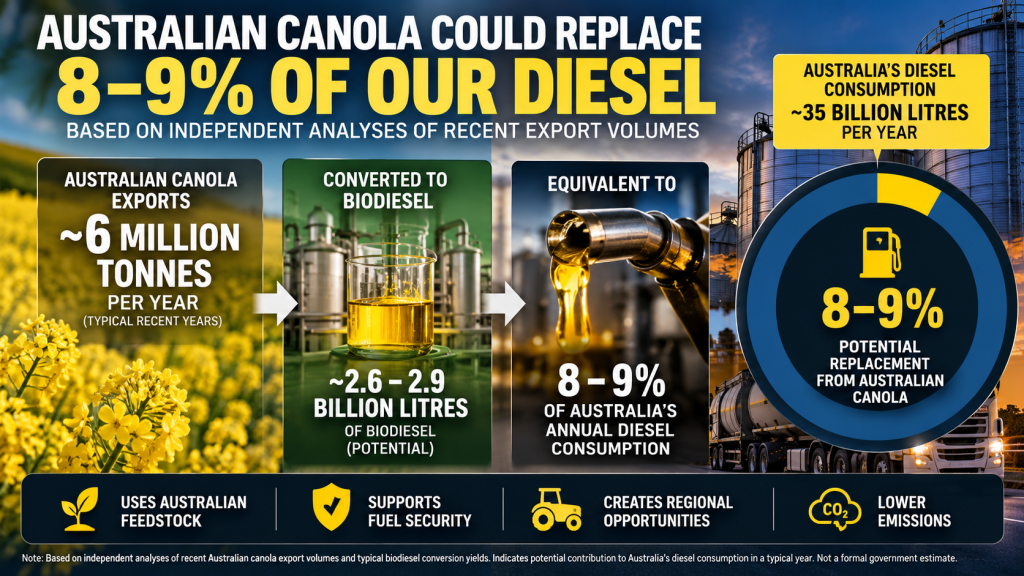
That does not mean Australia should burn its entire canola crop. Canola already has valuable food, feed and export markets. The strategic opportunity is more nuanced: tallow, used cooking oil, waste fats, canola and potentially other oilseeds could support a domestic renewable-diesel or biodiesel sector large enough to create a meaningful buffer.
Rabobank has highlighted the value-add imbalance directly: Australia exports millions of tonnes of relatively unprocessed canola while importing more than 30 billion litres of diesel annually. A domestic liquid-fuels industry would not eliminate import dependence, but it could diversify supply while creating another market for agricultural feedstocks.
Electrify the jobs that do not need diesel
Fuel security does not require waiting for a battery-powered replacement for every 500 horsepower tractor. A more practical approach is to preserve liquid fuel for applications that are genuinely hard to substitute — headers, heavy tractors, road trains and other high-duty mobile equipment — while progressively removing diesel from stationary or easily electrified loads.
- irrigation and bore pumping where grid or solar-battery systems are practical
- grain handling and stationary augers
- workshop power and refrigeration
- backup generation where batteries or hybrid systems can carry normal loads
- light vehicles and material-handling equipment where duty cycles suit electrification
IEEFA argues that efficiency, better maintenance and logistics optimisation could cut diesel use materially in transport, mining and agriculture. Demand reduction matters strategically: every litre no longer required for a substitutable task is another litre available to a header or truck during a genuine shortage.
What can farmers do on farm?
Individual farmers cannot change international refining policy, but they can reduce the chance that a short regional disruption becomes an operational failure. The objective should be resilience rather than hoarding.
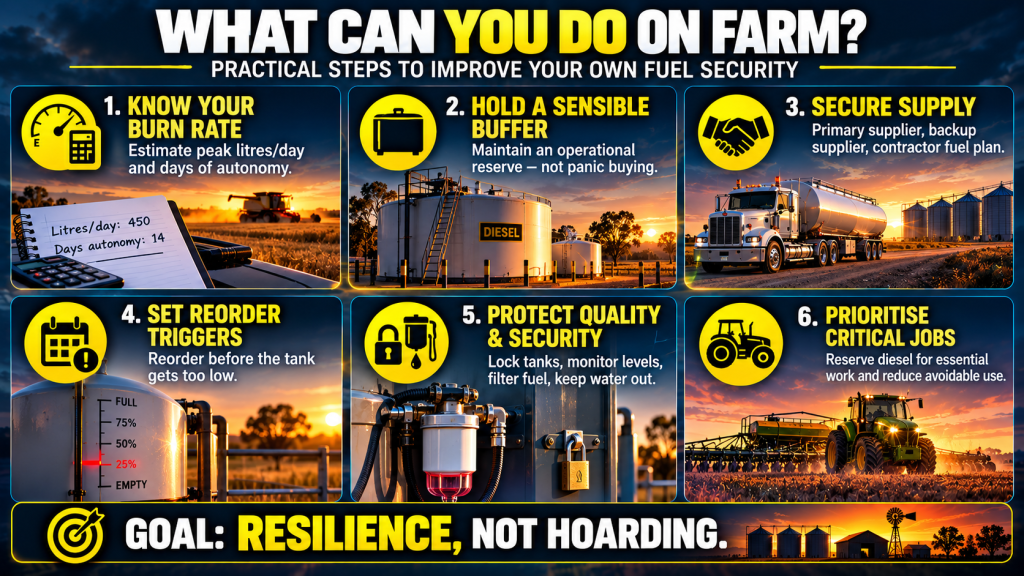
1. Know the farm’s peak burn rate
Work out litres per day during the operation that matters most — harvest, planting, spraying, haymaking or intensive freight. A farm that uses 300 litres on an average day but 1,500 litres during harvest has a very different resilience requirement from its annual average.
2. Hold a sensible operational buffer
The appropriate volume depends on tank capacity, local delivery frequency, machinery demand, regulations, insurance and cashflow. The principle is simple: enough fuel to bridge a realistic delayed delivery during a critical period, not enough to speculate on a shortage. Indiscriminate stockpiling can create safety, cashflow and community-supply problems.
3. Secure more than one supply path
Know the primary supplier, a backup supplier and how contractors source fuel. During peak periods, confirm expected delivery lead times rather than assuming normal turnaround still applies.
4. Set reorder triggers before the tank is low
Instead of waiting for a visual estimate that the tank is nearly empty, set a minimum reorder point based on peak daily consumption plus current delivery lead time. Remote level monitoring is inexpensive compared with losing a harvest day.
5. Protect fuel quality and security
A larger buffer is worthless if water, sediment, microbial contamination or theft makes it unusable. Keep tanks compliant, secured and monitored; manage water; maintain filtration; inspect hoses and vents; and rotate stored fuel rather than treating the tank as a permanent reserve.
6. Decide which jobs get fuel first
In a genuine shortage, farms should already know which jobs are critical and which can wait. Harvesting a mature crop, maintaining livestock water and essential freight may outrank non-urgent cultivation, discretionary travel or tasks that can be electrified or delayed.
The real lesson: make Australia harder to cut off
The US episode is instructive precisely because the export ban did not happen. In the space of about two days, a policy threat serious enough to move global markets was used to pressure allied countries into releasing emergency stocks and then withdrawn once a coordinated response was announced.
That is what a stressed global energy market looks like: policy, trade flows and physical supply can change far faster than Australian farms can redesign their energy systems.
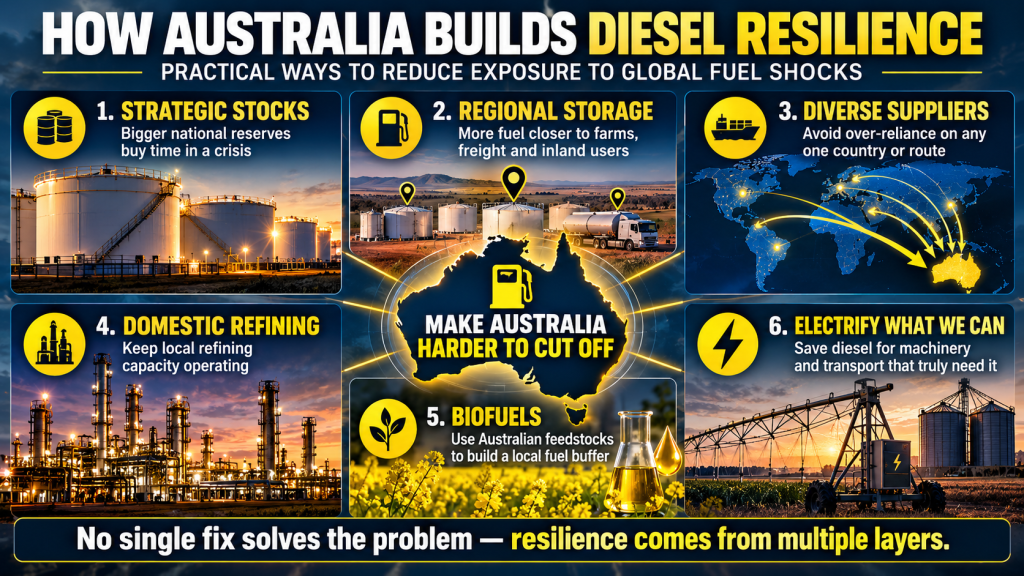
The realistic goal is therefore not total fuel independence. Australia is unlikely to replace every imported barrel economically, and domestic refineries themselves still depend on imported feedstock. A more credible objective is to make the system much harder to break:
- larger strategic reserves
- regional storage and distribution capacity
- multiple international suppliers and shipping routes
- retained domestic refining capability
- Australian renewable liquid fuels
- electrification and efficiency where diesel is not essential
- better on-farm planning before peak seasonal demand
The safest fuel system is not one that assumes a trusted foreign supplier will always remain open. It is one where no single overseas political decision can stop an Australian farm.
Sources and further reading
- Reuters — Chinese refiners suspend October fuel exports
- Reuters — Trump says US will not impose a diesel export ban
- Reuters — G7 to release 100 million barrels of emergency reserves
- Reuters — Russia extends diesel export restriction
- Australian Government — 3 October fuel supply update
- IEEFA — Managing Australia’s diesel squeeze
- DCCEEW — Australia’s Fuel Security and Resilience Package
- Rabobank — Biofuels could strengthen Australia’s fuel security
This article accompanies the In The Paddock video released on 4 October 2026. Figures reflect information available at the time of publication and may change rapidly as global fuel markets and government responses evolve.

