Australian agriculture has a diesel problem — but replacing diesel is much harder than replacing an engine.
In our previous episode we looked at how exposed Australian agriculture is to diesel prices, import dependence and supply disruption. That raises the obvious follow-up question: what actually replaces diesel?
For broadacre farming, the answer cannot simply be “buy an electric tractor”. A replacement has to pull a large air seeder for long shifts, keep a high-capacity header working through a narrow harvest window, avoid dramatically increasing labour, and — ideally — allow farmers to keep using the expensive machinery and infrastructure they already own.
The most interesting conclusion from looking across agriculture, mining and freight is that the future may not belong to one fuel. It may belong to electric drivetrains supplied by different energy sources according to the job.
The first problem: batteries have to carry the whole day’s energy
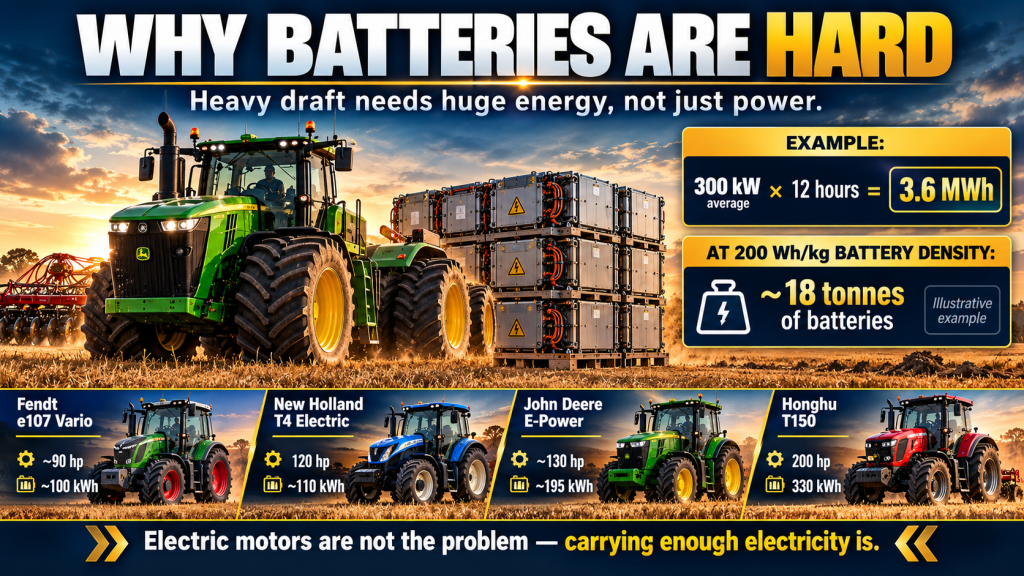
A 600 horsepower tractor is roughly a 447 kW machine. It will not use full rated power continuously, but heavy draft work can still demand hundreds of kilowatts for many hours.
Take a simple illustration: if a tractor averaged 300 kW for 12 hours, it would consume about 3.6 MWh of energy. At an illustrative pack-level battery energy density of 200 Wh/kg, that amount of stored energy alone would equate to around 18 tonnes of battery before reserve capacity, cooling, structural protection and other systems were considered.
That calculation is not a forecast of what every future electric tractor will weigh. It simply explains why most battery-electric agricultural machines remain far smaller than the 500–700 hp tractors used for the heaviest Australian sowing work.
The current battery-electric benchmarks
- Fendt e107 Vario — roughly 90 hp peak with a battery around the 100 kWh mark.
- New Holland T4 Electric Power — around 120 hp peak, aimed at lower-power farm, utility and livestock work.
- John Deere E-Power development tractor — around the 130 hp class, using an 800 V modular battery architecture.
- Honghu T150 — a Chinese research platform at roughly 200 hp with a 330 kWh LFP battery.
The important point is that electric motors themselves are not the limitation. Electric motors are already capable of moving enormous mining trucks and locomotives. The difficult part is carrying enough electrical energy into a paddock for an entire high-load shift.
Honghu T150: China’s 200 hp battery tractor takes a different approach
The Honghu T150 (鸿鹄T150) is one of the more interesting battery-electric agricultural machines because it attempts to solve the endurance problem with battery swapping and autonomy rather than simply making the battery indefinitely larger.
- About 147 kW / 200 hp tractor class.
- 330 kWh lithium-iron-phosphate battery.
- Technical literature reports two 150 kW permanent-magnet motors.
- Approximately 11 tonnes.
- Cabless and autonomous.
- Reported operating endurance of more than four hours under load in development testing.
- Designed around rapid battery replacement.
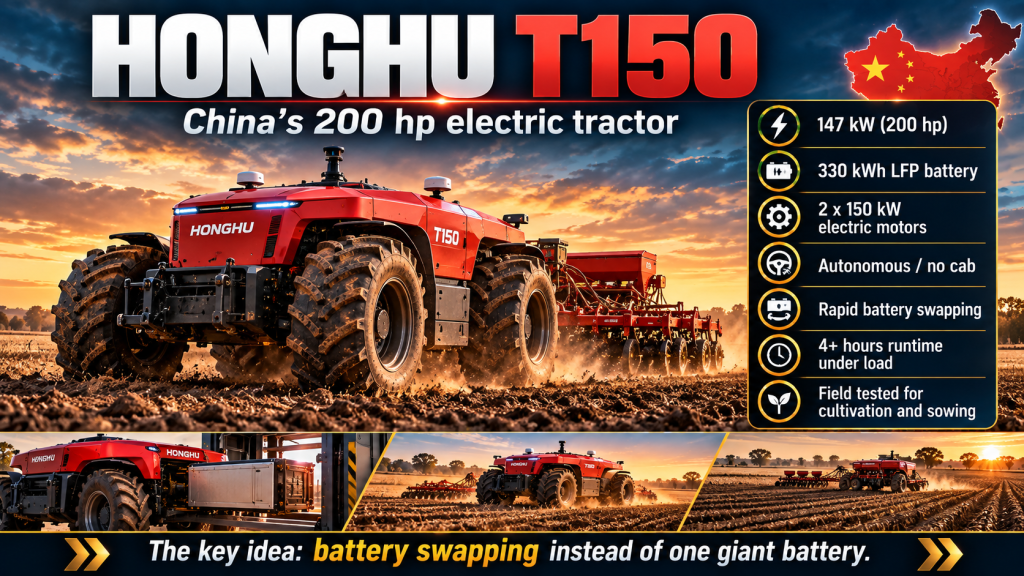
That operating model matters. Rather than asking one battery to last an 18-hour day, one battery can work while another charges. A depleted pack is swapped and the tractor returns to work.
This is particularly logical when combined with autonomy. If the machine is unmanned, a short battery-change stop every few hours may be easier to tolerate than it would be with a highly paid operator waiting in the cab.
The T150 has also been used in field demonstrations for cultivation and wheat sowing, making it more than a styling exercise. It remains a research/development platform rather than a conventional commercial tractor, but it shows one plausible route for medium-power electric field machinery.
Mining’s lesson: electrify the drivetrain before eliminating the fuel
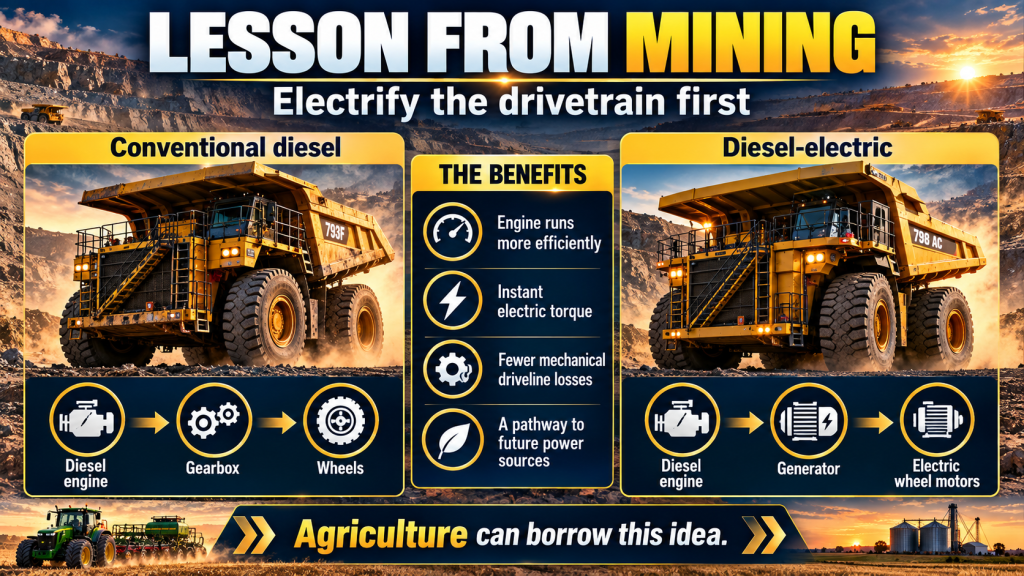
Mining is useful because haul trucks face many of the same problems as broadacre machinery: high power, long operating hours, expensive assets and severe penalties for downtime.
Large haul trucks have used diesel-electric architecture for decades. Instead of mechanically coupling the engine to the wheels through a conventional transmission, the diesel engine drives a generator and electrical power is sent to traction motors.
This separates the energy source from the drivetrain. The combustion engine can spend more of its time near an efficient operating point, while electric motors provide rapid torque response and eliminate some mechanical transmission components.
Zoomlion DX7004: hybrid power reaches genuine broadacre horsepower
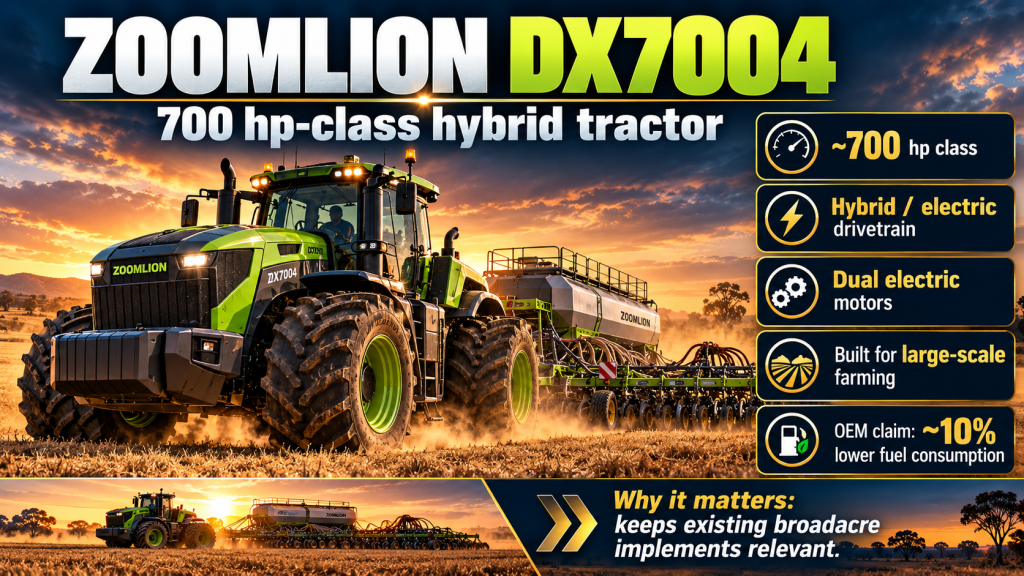
The Zoomlion DX7004 is important because it moves hybrid/electric agricultural machinery into the power class that actually matters for large Australian air-seeder work.
- Approximately 700 hp class.
- Hybrid/electrified drivetrain with dual electric-drive architecture.
- Designed for high-load, large-scale field work.
- Zoomlion has claimed around 10% lower overall fuel consumption, depending on application.
- The machine was shown in Australia at AgQuip 2026.
More significantly, the DX7004 has now moved beyond being purely a show concept: Zoomlion announced the first commercial delivery in China in September 2026. That does not yet make it an established Australian production tractor, but it shows the architecture is progressing beyond prototype stage.
The key attraction for Australian farming is that the tractor can remain compatible with conventional implements. The farmer does not necessarily need to replace the air seeder because the tractor’s internal method of moving power has changed.
John Deere eAutoPowr: electrifying the transmission, not the whole tractor
John Deere’s eAutoPowr takes a more incremental approach. The tractor still uses a diesel engine, but electric motor-generators replace the hydrostatic element of the continuously variable transmission.
Deere says the variable power path can be about 8% more efficient than the hydrostatic equivalent. The significance is not just fuel efficiency: a high-voltage electrical architecture also creates the possibility of sending useful electrical power to an implement.
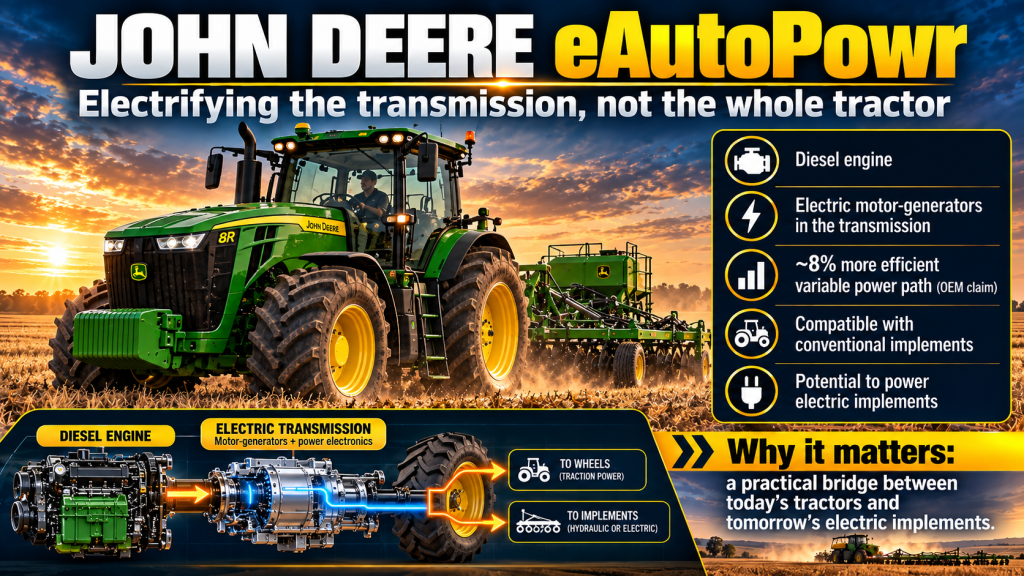
That matters because some of the biggest gains may come from electrifying the tractor and implement as one system, rather than treating the tractor as the only source of traction and mechanical power.
The electric air-cart idea: make the seeder help pull itself
This is a development concept rather than a product currently offered by Deere or Zoomlion, but it follows technology that already exists elsewhere.
A large Australian air cart can carry tens of tonnes of seed and fertiliser. At present, most of that weight is simply additional mass the tractor has to drag. But that same weight sits directly over the air cart’s wheels.
Put electric motors on one or more air-cart axles and supply them from a high-voltage tractor, and the cart could contribute its own traction. Electric fans and metering could also be supplied from the same bus.
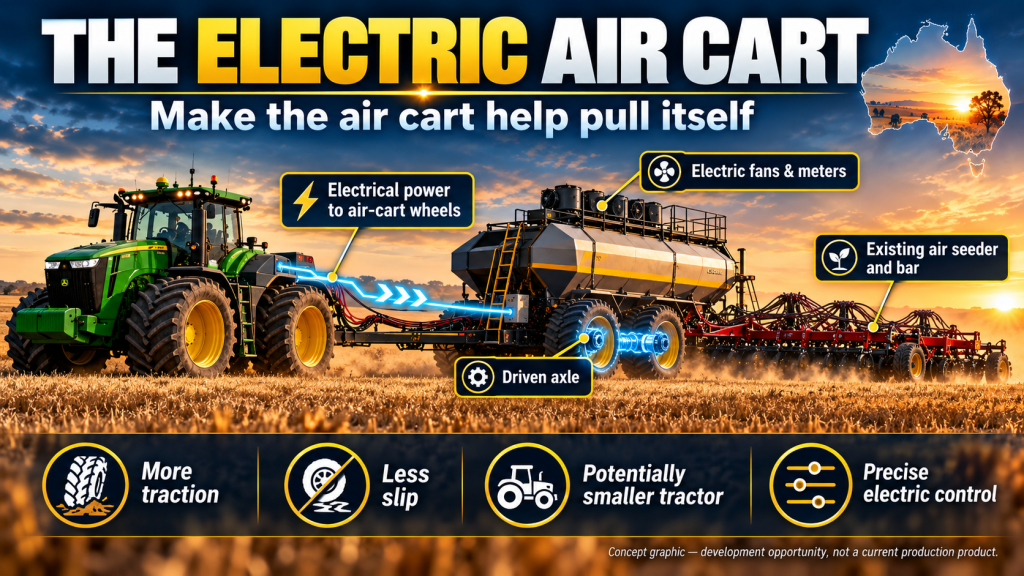
- More useful traction from the air-cart mass.
- Potentially less tractor wheel slip.
- Potentially less ballast.
- A smaller tractor may be able to pull the same overall seeding system.
- Existing bars, tanks and much of the farmer’s air-seeding investment could remain in service.
John Deere has already demonstrated tractor-to-implement electrical power in other applications. The interesting question for broadacre Australia is whether that concept could be pushed into large air carts and seeding bars.
Zoomlion H7-600E: perhaps the most important machine in the discussion
If heavy sowing is hard to electrify, harvest may be harder again. A combine has to propel itself while simultaneously powering the header, feederhouse, threshing and separation system, cleaning shoe, residue management and unloading auger.
That is why the Zoomlion H7-600E hybrid combine deserves attention.
- Approximately 480 hp diesel engine.
- Only an 11.55 kWh battery.
- More than 600 hp peak combined/system output.
- Distributed electric-drive architecture.
- Zoomlion claims more than 30% lower energy consumption.
- The company also claims around 70% fewer transmission components and around 20% greater operating efficiency.
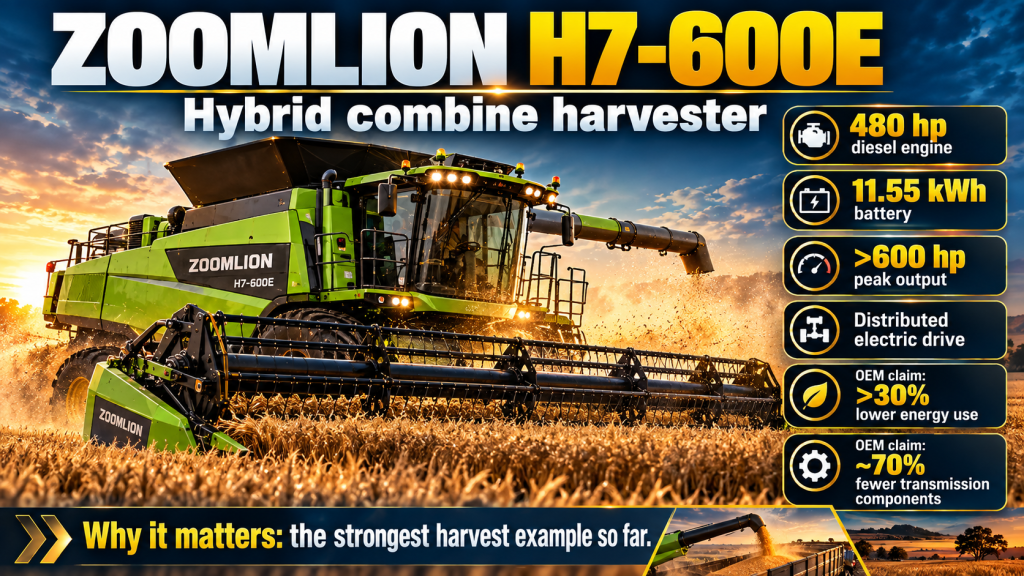
Those performance figures are manufacturer claims and should be treated as such until they are independently tested in Australian crops. But the architecture itself is the important part.
An 11.55 kWh battery is tiny compared with the multi-megawatt-hour energy requirement of a battery-only harvest shift. It can instead act as a buffer for peak loads while the diesel engine supplies the sustained energy and electric motors distribute that power around the machine.
That may be a much more realistic path for high-capacity harvesters than attempting to put several tonnes — or tens of tonnes — of batteries into a combine.
Mining’s second lesson: don’t carry all the energy onboard
Trolley-assist mining trucks provide another useful comparison. A diesel-electric haul truck can operate normally around a mine, then connect to overhead electrical power on the highest-energy section of the haul road.
Komatsu says trolley assist can reduce fuel use by as much as 70% in suitable applications. Caterpillar says diesel consumption while connected to trolley power can fall by more than 90% in appropriate conditions.
No one is seriously suggesting stringing trolley wires across every cropping paddock. The point is conceptual: the vehicle does not necessarily have to carry every unit of energy it will consume during the day.
That is the same logic behind battery swapping, powered implements, field charging and other systems that move some of the energy problem away from the prime mover itself.
Freight’s lesson: different jobs need different energy sources
Heavy road freight is reaching a similar conclusion. Battery-electric trucks are increasingly viable where routes are predictable and charging can be planned. Hydrogen continues to attract attention for longer-duration work where energy storage and rapid replenishment are more difficult.
Mercedes-Benz’s eActros 600 is designed around roughly 500 km of battery-electric range in appropriate long-haul operation. Daimler is simultaneously developing its NextGenH2 fuel-cell truck, targeting more than 1,000 km using liquid hydrogen and a comparatively small buffer battery.
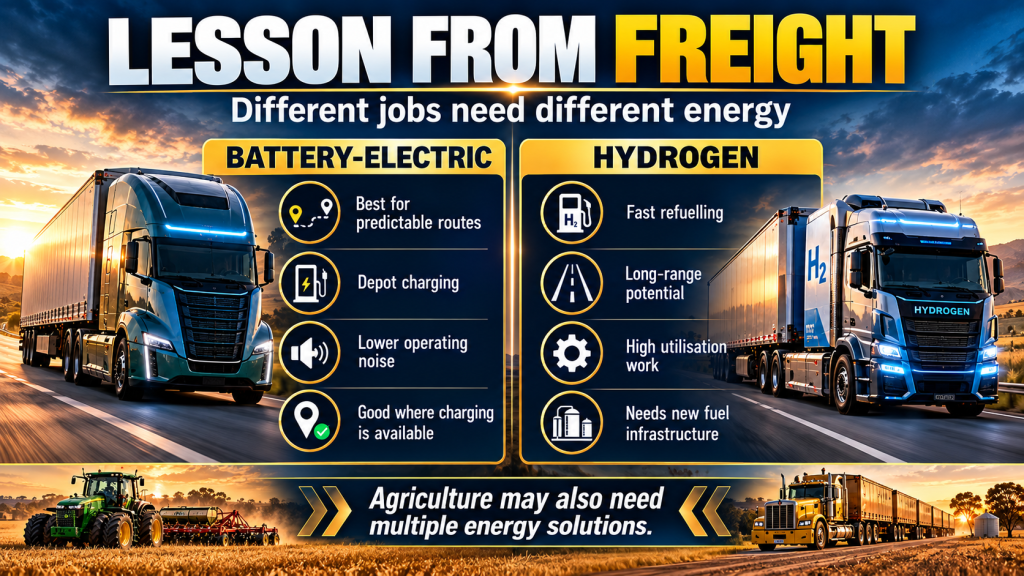
Agriculture has exactly the same diversity of duty cycles. A loader tractor feeding cattle each morning is not the same energy problem as a 700 hp tractor pulling an air seeder for 18 hours. One technology does not have to win every job.
Hydrogen: still in the conversation because high-power endurance is difficult
Kubota has demonstrated an autonomous hydrogen fuel-cell tractor around the 100 hp-equivalent class. In a fuel-cell machine, stored hydrogen is converted into electricity, which then powers electric traction motors.
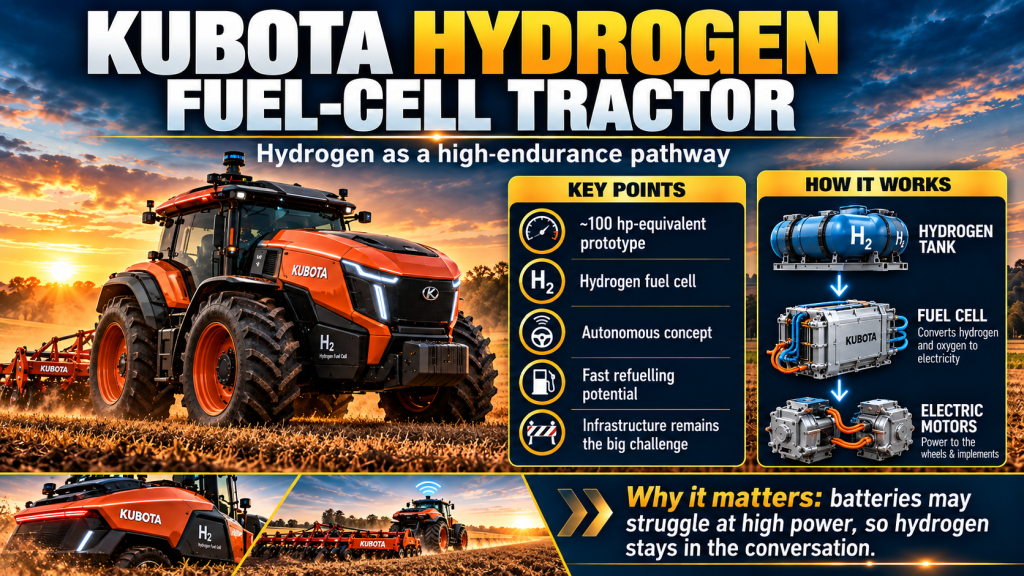
Hydrogen’s appeal is straightforward: refuelling can potentially be much faster than recharging a multi-megawatt-hour battery, while onboard energy storage can be greater than a practical battery pack of similar mass.
Its disadvantages are equally significant. Hydrogen has difficult storage requirements, rural refuelling infrastructure is largely absent, and the cost and efficiency of producing low-emissions hydrogen remain major questions.
AGCO Power has also investigated hydrogen combustion and hybrid approaches. However, we have not yet seen a convincing commercial 500–700 hp hydrogen broadacre tractor or a Class 10/11 hydrogen combine.
New Holland T7 Methane Power: an alternative fuel that has reached production
New Holland has pushed methane further into commercial agriculture than most alternative fuels. The T7.270 Methane Power sits around the 270 hp class and can operate on methane or biomethane.
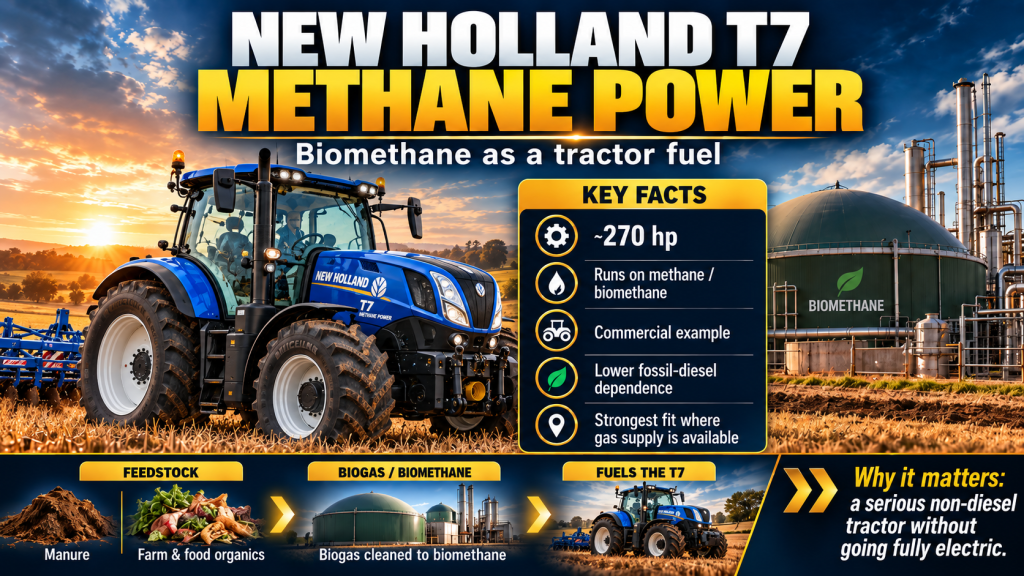
This becomes especially interesting where a farm or nearby industry can produce biomethane from manure or organic waste. A dairy, feedlot or intensive livestock business may be able to create a much stronger closed-loop fuel case than a remote grain-only enterprise.
New Holland has also demonstrated an LNG-fuelled T7 prototype. LNG stores more energy onboard than compressed methane, which points toward a possible path to larger machinery, although there is still no production T9 or Steiger-class methane tractor equivalent to the largest diesel machines.
HVO renewable diesel: the least revolutionary option may be the easiest
Hydrotreated vegetable oil (HVO) or renewable diesel is different from the drivetrain technologies above because it allows approved existing diesel engines to continue operating with minimal machinery change.
That is its biggest advantage. A farmer can potentially retain the tractor, combine, air seeder, chaser bin, fuel storage and workshop systems they already own.
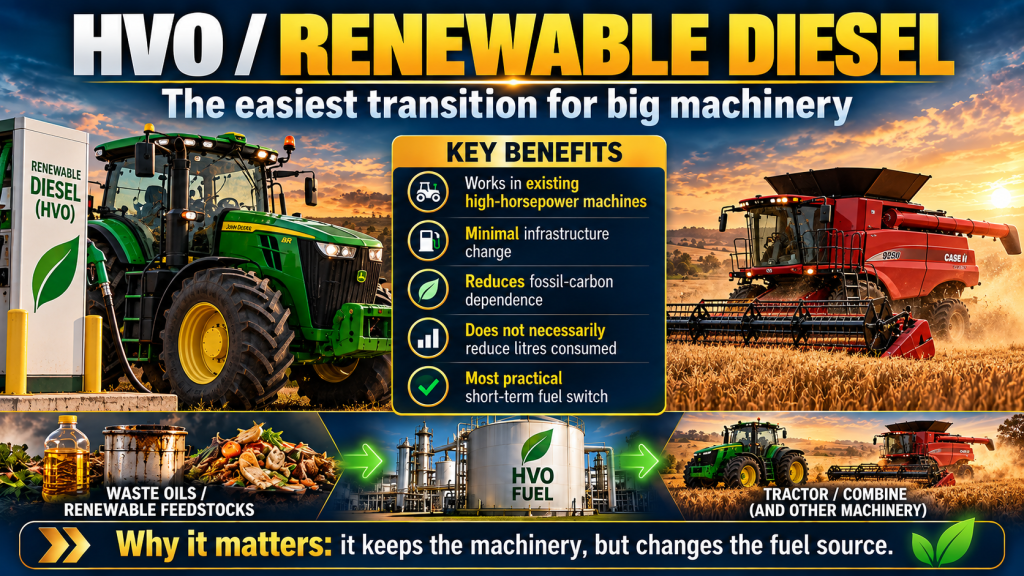
HVO can substantially reduce lifecycle fossil-carbon emissions depending on feedstock and production method. But it is important not to confuse carbon reduction with energy efficiency: HVO does not inherently make the machine consume fewer litres.
For Australia, that distinction matters. Renewable diesel could reduce dependence on fossil crude, but if the country still needs roughly the same number of litres delivered into regional fuel tanks, many of the logistics and energy-security questions remain.
Methanol and ammonia: energy carriers rather than immediate tractor fuels
Methanol and ammonia are also being investigated as ways of carrying energy into heavy machinery.
Methanol is attractive because it is a liquid under normal conditions and can potentially be reformed into hydrogen onboard to feed a fuel cell. AGCO has demonstrated methanol-based range-extender work on smaller electric agricultural platforms.
Ammonia can also act as a hydrogen carrier and has the advantage that agriculture already understands ammonia as an industrial commodity. Amogy has demonstrated ammonia-to-power technology on a tractor platform, but the approach remains experimental for practical broadacre use.
The bigger idea: power-agnostic machinery
Perhaps the most important lesson again comes from mining. Komatsu has been developing a power-agnostic version of its 930E haul truck: an electric-drive truck whose onboard energy source can evolve over time.
Translate that idea to agriculture and the future tractor could be built around:
- electric traction motors;
- a high-voltage electrical bus;
- electrically driven auxiliaries and implement functions;
- conventional agricultural interfaces such as hydraulics, PTO and ISOBUS where still required;
- a modular energy source.
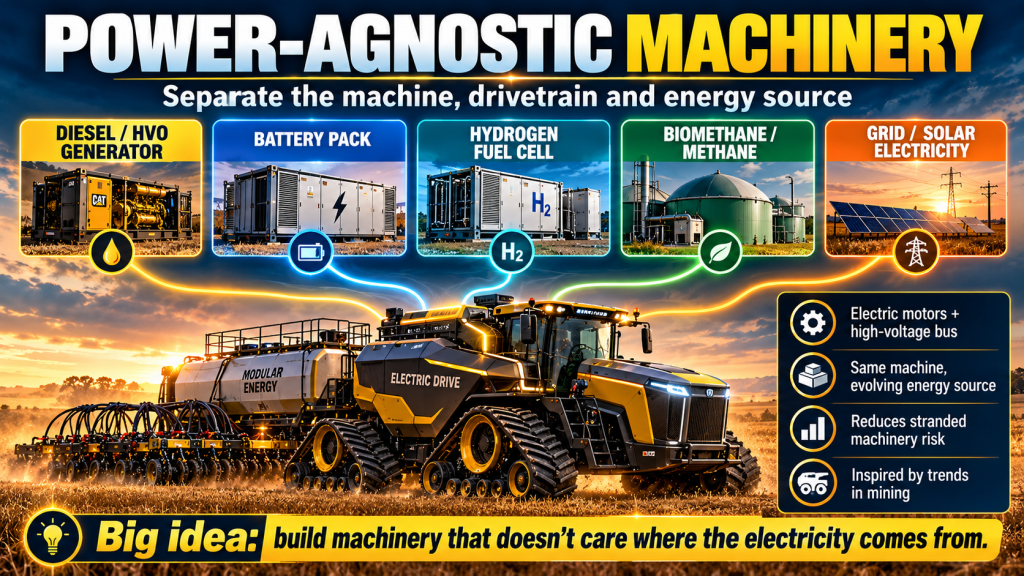
The first generation might use a diesel generator. A later version could run the same generator on HVO. Another could use a hydrogen fuel cell, improved batteries, biomethane or a different range extender.
Maybe the better question is not “what fuel replaces diesel?” but “how do we build machinery that does not care where its electricity comes from?”
What the mixed-energy farm may actually look like
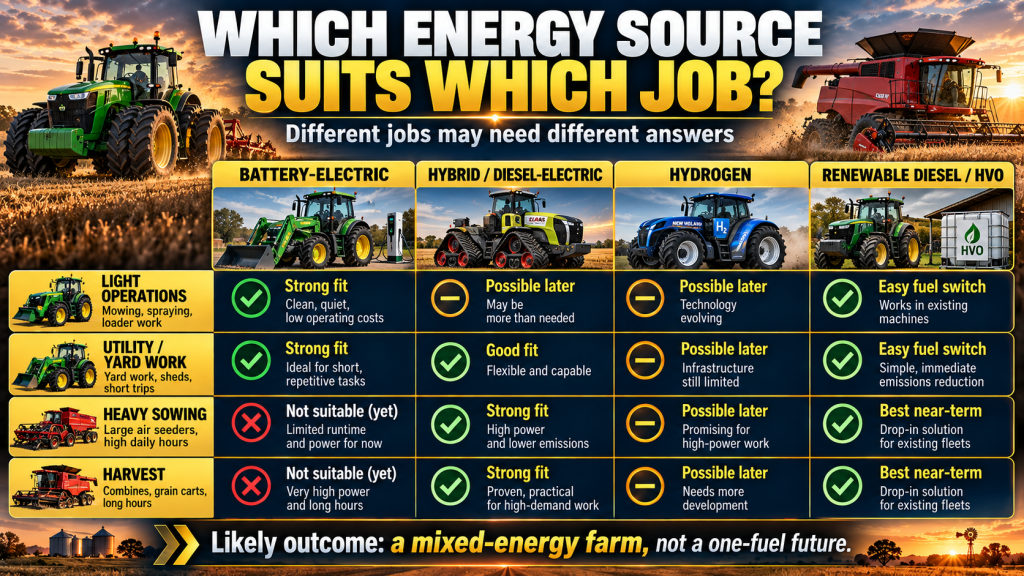
The most believable future is not battery everything, hydrogen everything or one universal replacement fuel. It is a mixed system in which the energy source is matched to the duty cycle.
Light and repetitive work
Battery-electric machinery makes increasing sense for utility tractors, loaders, yard work, spraying and other predictable tasks where charging can occur between shifts or overnight.
Autonomous medium-power field work
Machines similar to the Honghu T150 suggest that battery swapping and autonomy could allow smaller electric tractors to work long days without needing one enormous onboard battery.
Heavy sowing
The near-term answer may look more like the Zoomlion DX7004: a 500–700 hp hybrid/electric-drive tractor retaining a dense liquid fuel for endurance, potentially combined with electrically assisted implements such as a driven air cart.
Harvest
The H7-600E points toward a high-capacity combine with a smaller or more efficiently operated liquid-fuel engine, a small battery buffer and distributed electric drives rather than a giant traction battery.
Farm energy
Grid electricity and farm solar can charge battery machines where it makes sense. Renewable liquid fuels can cover jobs requiring very high energy density. Hydrogen or biomethane may become viable in particular regions or businesses where the fuel can be produced or supplied economically.
The first tractor that replaces diesel may still contain a diesel engine
That sounds contradictory, but it may be the most realistic conclusion.
The first step away from complete diesel dependence does not have to be eliminating the engine overnight. It may be electrifying the transmission, reducing engine size, allowing batteries to handle transient loads, powering implements electrically and making every litre of fuel do more work.
From there, the fuel supplying the electric drivetrain can change as technology and infrastructure improve.
For Australian agriculture, that is potentially much more useful than waiting for a perfect zero-diesel machine that can immediately replace every 700 hp tractor and Class 11 combine.
The transition may begin not by getting rid of diesel, but by making sure we stop wasting it.
Further reading and technical sources
- Zoomlion — DX7004 hybrid tractor
- Zoomlion — H7-600E hybrid combine
- John Deere — eAutoPowr electric variable transmission
- Kubota — hydrogen fuel-cell tractor development
- New Holland — T7.270 Methane Power
- Komatsu — trolley-assist mining technology
- Caterpillar — trolley-assist mining trucks
- Daimler Truck — battery-electric versus hydrogen heavy freight
- Review of electric tractor development in China, including Honghu T150
- Technical review — Honghu T150 battery and motor architecture
Specifications and efficiency figures quoted from manufacturers are identified as manufacturer claims where appropriate. Technologies discussed range from commercial machines to prototypes and research platforms, so availability and performance can vary significantly by market and application.

