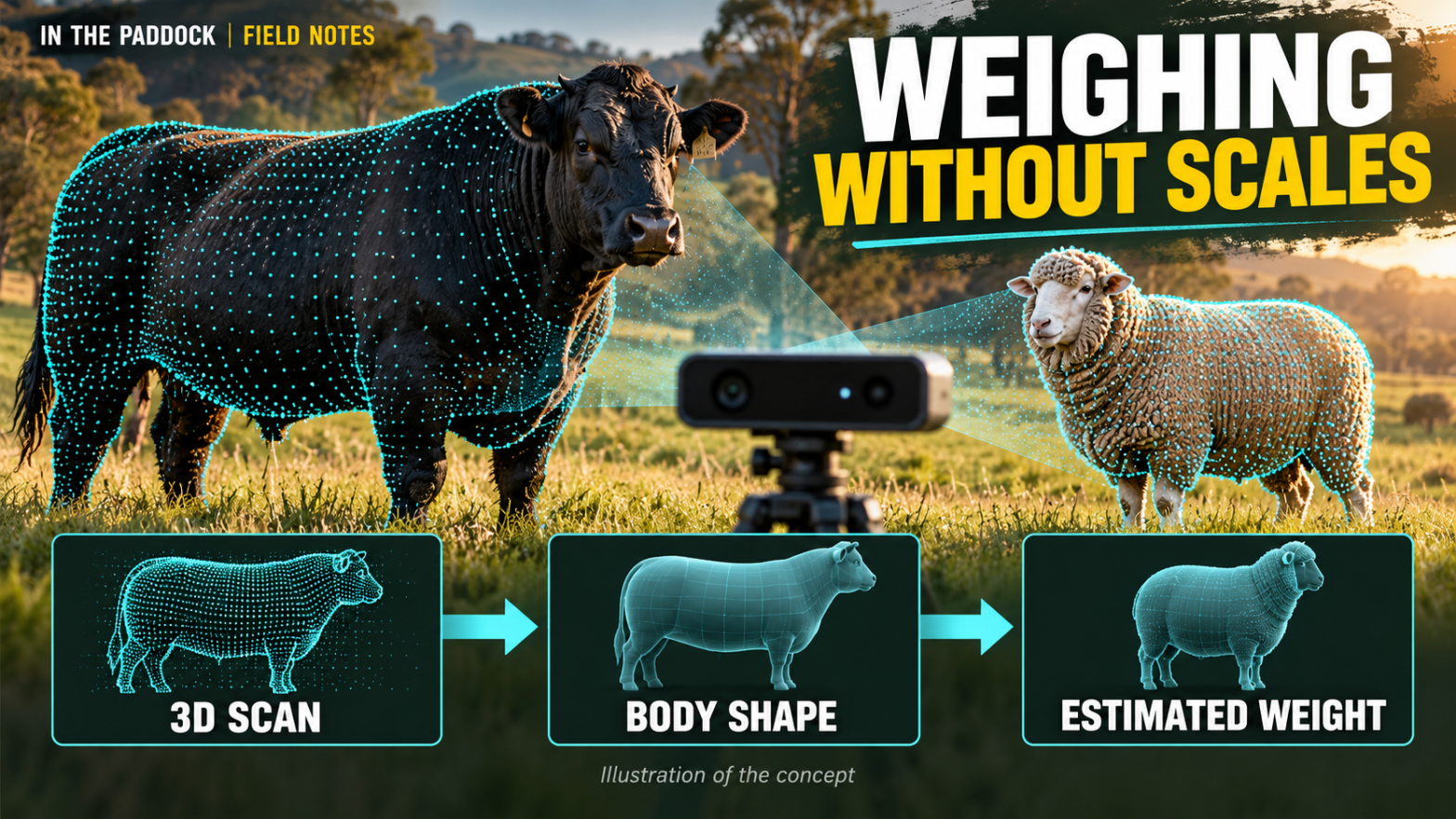
Could a phone replace some trips through the cattle scales? Could a camera record sheep weights as animals pass through a gateway? Those are increasingly practical research and development questions. The harder question is whether the resulting estimates are dependable enough to guide a feeding or sale decision.
In this In The Paddock — Field Notes companion article, we look at Scanabull’s cattle technology and FlockMate, the Australian sheep-imaging project. Both point towards easier collection of livestock performance data, but they are different systems at different stages of development.
By Martin Murray, farmer and agronomist. Evidence and product information checked 19 October 2026. This is an assessment of published material, not a hands-on product trial.
Why easier weighing could matter
A weigh day tells us what animals weigh at that moment. It can also tell us how they have performed since the previous measurement. What it cannot do is show exactly when performance changed in between. If a mob’s growth slows after a pasture change, the delay before the next weighing may postpone the investigation.
Consider a hypothetical mob of 100 cattle expected to gain 1.0 kg a day but actually gaining 0.6 kg. Over 30 days, that difference becomes 12 kg per head, or 1,200 kg across the mob. This is arithmetic, not a measured benefit from either technology. Detecting the shortfall sooner could be useful only if the producer can identify its cause and take an effective action.
That is the commercial opportunity: better-timed information. Saving labour is valuable, but so is knowing whether the feed budget is working. A camera does not create extra kilograms; management informed by trustworthy data might.
How a camera estimates liveweight
Conventional scales measure the load an animal places on a weighing platform. An imaging system captures information about its visible shape and uses a model to infer weight. Depth information adds dimensions that a flat photograph cannot directly provide. The final number is therefore a prediction, whose usefulness depends on the model and the quality of its input.
That distinction should shape how we judge the technology. A convincing body outline is not, by itself, evidence of an accurate weight. The relevant comparison is the estimate against a suitable reference measurement, including animals and conditions the model has not simply memorised.
FlockMate brings sheep and fleece into the picture
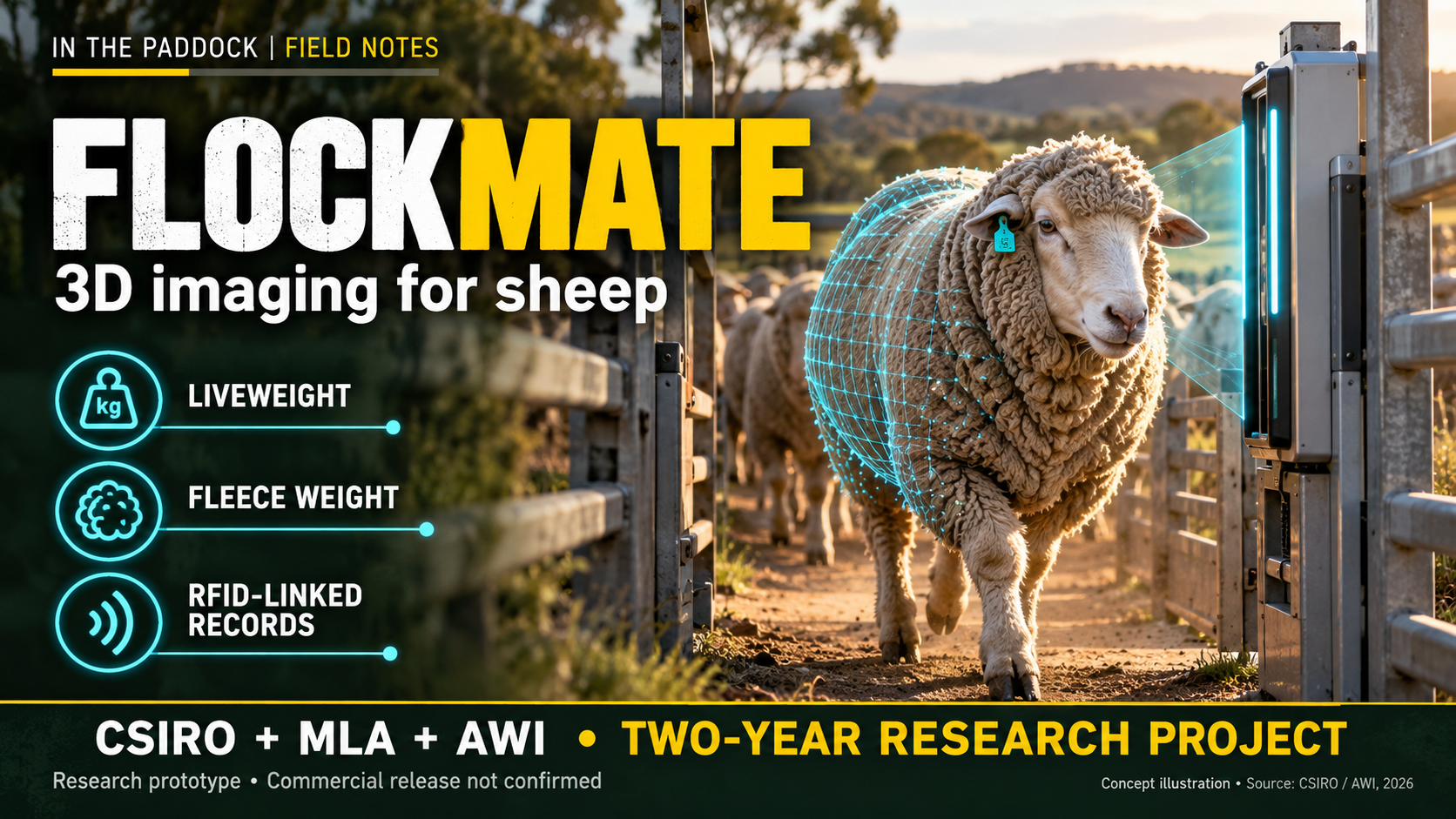
The MLA announcement on 30 March 2026 introduced FlockMate as an off-animal prototype project. CSIRO’s July update describes a two-year collaboration funded by CSIRO, Meat & Livestock Australia and Australian Wool Innovation. Its approach combines high-resolution 3D imaging, computer vision and RFID-linked records to estimate sheep body volume, liveweight and fleece weight.
Early work is taking place at Chiswick Research Station near Armidale. The property covers 1,500 hectares and runs about 2,700 breeding Merino ewes. Those numbers describe the research setting; they must not be mistaken for a published validation sample.
AWI’s September development update reports input from more than 20 producers and confirms that refinement and validation are continuing. The reviewed announcements do not provide a numerical accuracy result, retail price or confirmed commercial release date.
For a sheep producer, fleece estimation raises an interesting management question. How much of a change in the reported animal weight reflects tissue, and how much reflects wool? That does not mean the system has already solved the problem. It means performance should be tested across relevant fleece conditions, rather than judged from a single attractive demonstration.
Scanabull has two distinct cattle approaches
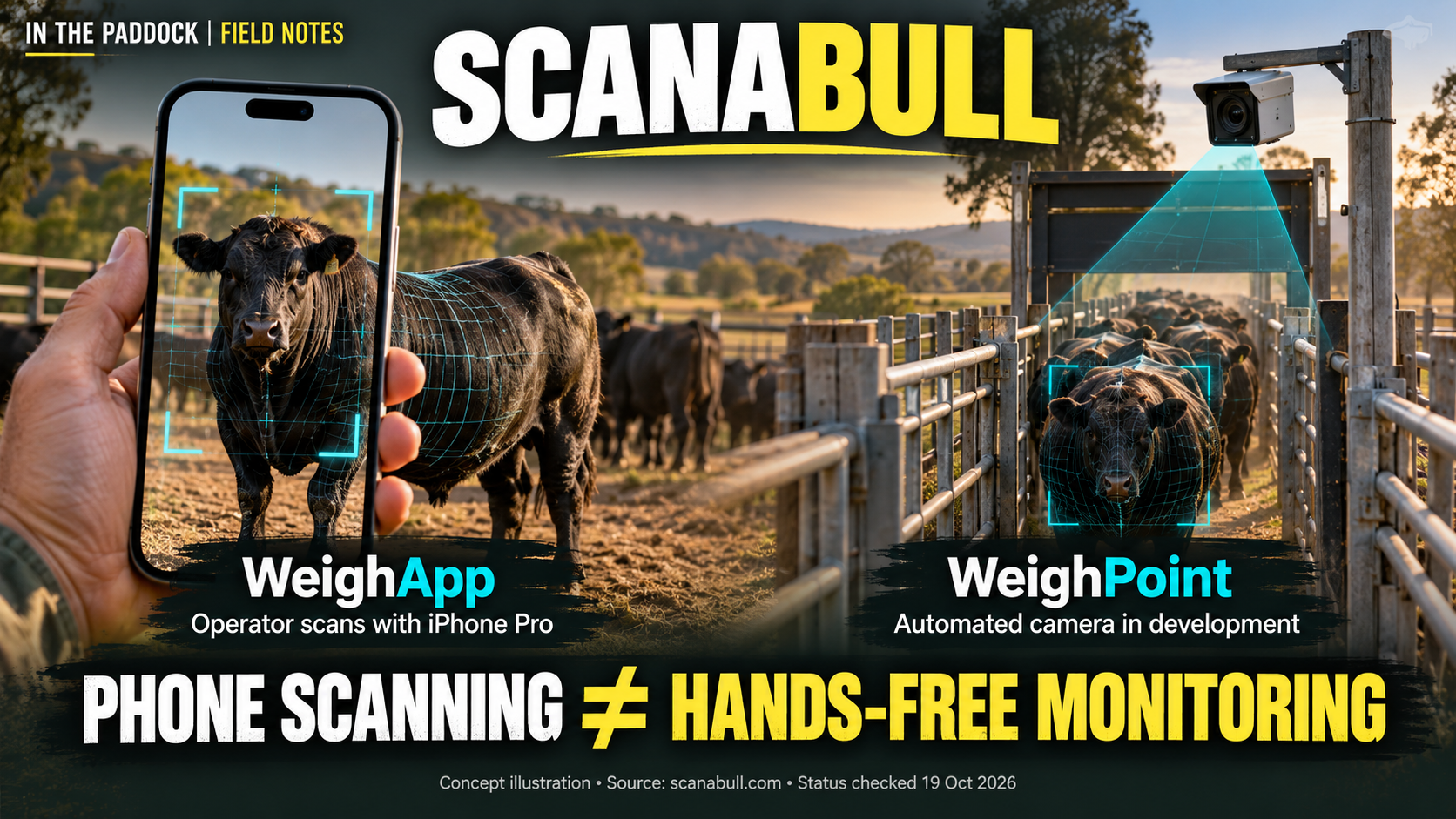
Scanabull describes WeighApp as its iPhone Pro scanning product and WeighPoint as a separate automated camera in development. The distinction matters: an operator collecting phone scans is not the same arrangement as an unattended unit collecting records whenever animals pass.
| System | How records are intended to be collected | Current qualification |
|---|---|---|
| FlockMate | Sheep pass a sensor system; estimates link to RFID | Research and development |
| Scanabull WeighApp | An operator scans cattle using an iPhone Pro | Website retains early-access and future-release messaging |
| Scanabull WeighPoint | Dedicated camera intended for automated monitoring | In development; future release |
A company funding report published in April says Scanabull was founded in 2024, raised NZ$1.1 million and trained models on more than 100,000 animal data points. Data points are not necessarily unique animals. Funding and training-data volume provide development context, but neither substitutes for validation on the cattle a buyer actually runs.
The phone approach could suit occasional checks where permanent equipment is inconvenient. An automated camera could offer a different benefit: repeated observations without an operator performing each scan. Both still depend on practical access to the animals and usable records.
What the reported accuracy figures do and do not tell us
In its technical explanation, Scanabull describes using multiple frames and filtering unsuitable images. It reports the following September comparisons and development targets:
| Company-reported measure | Figure |
|---|---|
| Mean individual accuracy, one farm dataset dated 2 September 2026 | 94.3% |
| Accuracy of that mob’s predicted average | 97.1% |
| Reported September mob comparisons to that point | 97–99% |
| Development targets, not guarantees | 96% individual average; 98% mob average |
Scanabull acknowledges individual and occasional whole-mob outliers. These manufacturer-reported percentages are not guaranteed error limits for every animal, and the page does not supply a full independent validation protocol.
Before comparing competing products, ask what “accuracy” means mathematically. Is the supplier reporting average absolute percentage error, agreement of mob means, a correlation or another statistic? These answer different questions. A high correlation can coexist with a consistent overestimate, while a good average can conceal large errors in opposite directions.
The mob can look right while individual animals are wrong
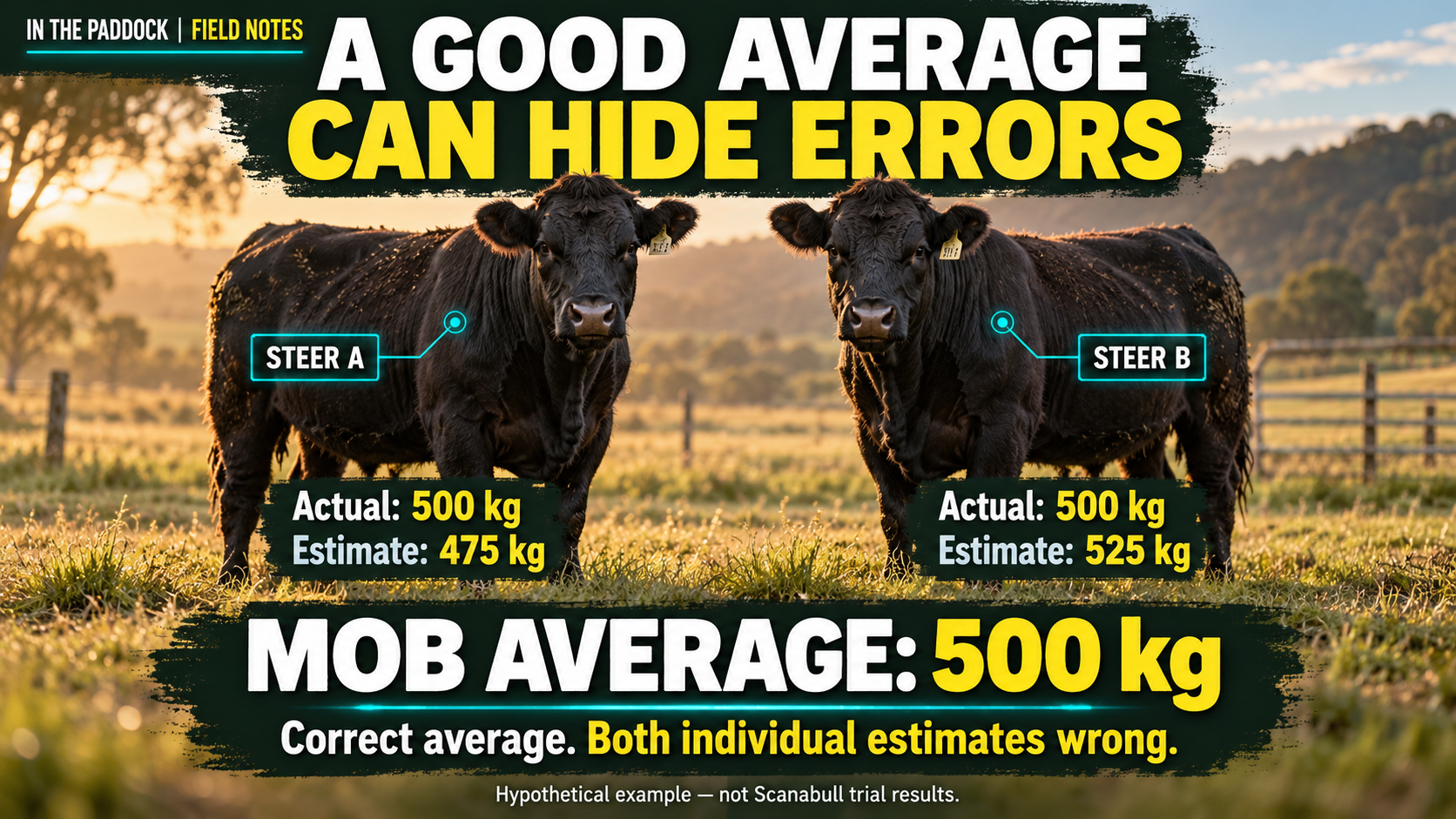
Imagine two steers that each actually weigh 500 kg. A camera estimates one at 475 kg and the other at 525 kg. The estimated mob average is exactly 500 kg. Yet both individual estimates are wrong by 25 kg. This is a hypothetical demonstration of error cancellation, not a Scanabull trial result.
For some mob-level feeding decisions, a well-supported group estimate may be useful. For choosing which particular animals meet a weight target, individual error becomes much more important. The same technology can therefore be useful for one job without being sufficiently dependable for another.
Growth monitoring adds another complication. At 1 kg a day, a steer gains only 7 kg in a week. If variability between readings is larger than that change, subtracting two individual estimates may produce a misleading growth rate. Repeated observations can help manage random noise, but do not automatically correct systematic bias. Changing posture, scanning conditions or animal coverage can also complicate interpretation.
What I would test before relying on it
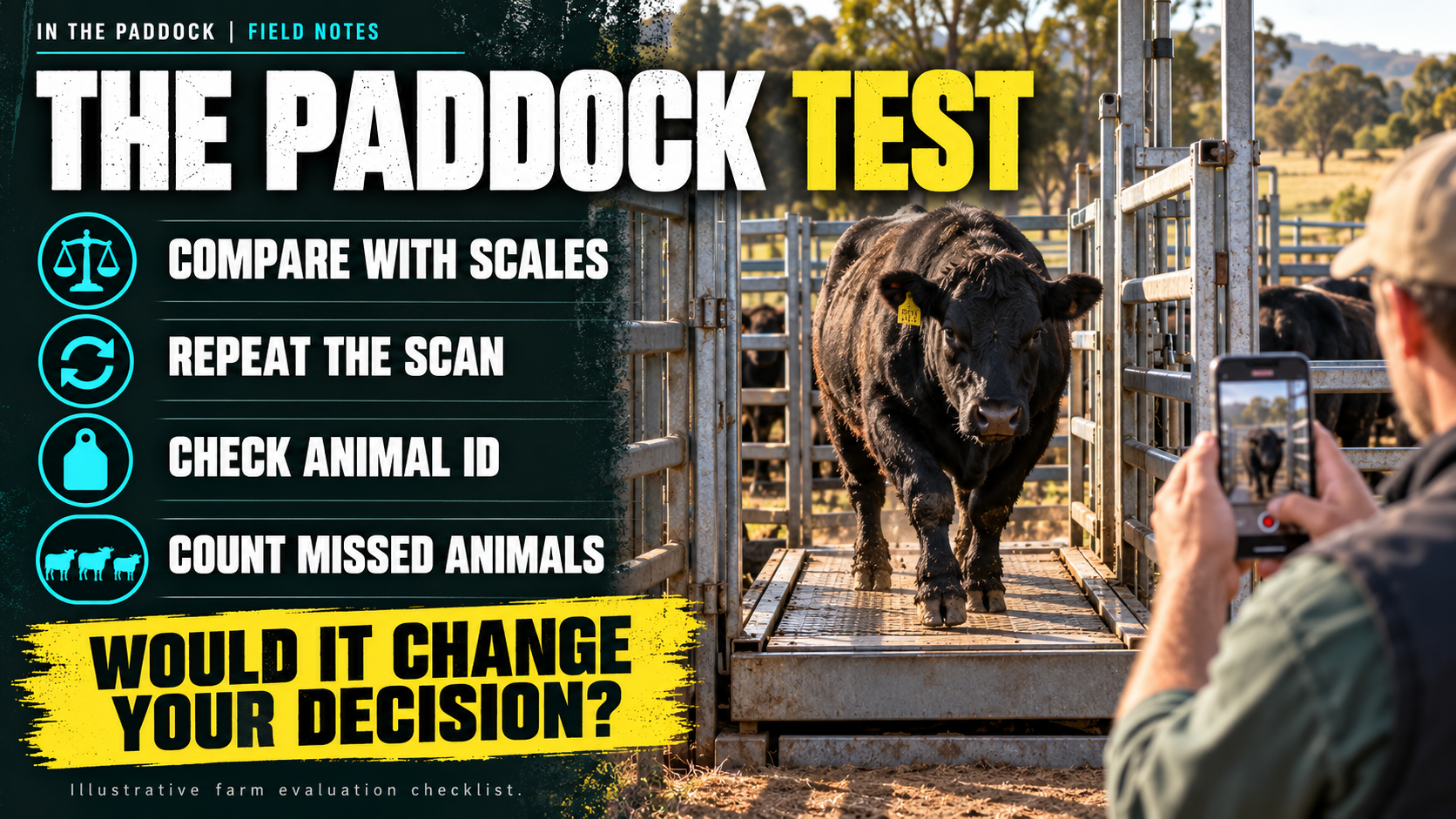
I would start with the decision I want the information to support, then design a comparison around that decision. A useful trial would include ordinary animals and ordinary operating conditions, not just the easiest animals to scan.
- Match the reference. Compare scans with checked livestock scales at closely matched times. Record the sequence and handling conditions so differences are not casually attributed to the camera.
- Repeat measurements. Scan the same animals more than once. Look at consistency as well as average agreement with scales.
- Inspect individual errors. Ask for errors in kilograms and percentages, the spread of results and the largest misses. Do not stop at the mob mean.
- Count failures. Record animals that produce no usable result. A system can look accurate if difficult cases silently disappear from the dataset.
- Check identity. Confirm that each record belongs to the correct animal. A plausible weight attached to the wrong tag can undermine the growth history.
- Test relevant conditions. Include the breeds, weight ranges, fleece states and viewing conditions that matter to the enterprise.
- Check the workflow. Assess exports, record access, connectivity needs, power, cleaning and the time required to keep the system working.
For automated installations, passage coverage deserves particular attention. A busy camera does not necessarily mean the whole mob has been recorded. Some animals may pass repeatedly while others are rarely seen. The useful measure is the proportion of distinct animals receiving usable records over the period that matters to the decision.
Costs depend on how often you want to measure
Scanabull’s pricing page lists indicative pre-launch plans. It does not explicitly identify the currency, so the figures below must not be treated as Australian-dollar quotes. Features and pricing are subject to change, and broad Australian availability remains unverified.
| Plan | Advertised monthly price | Annual scan allowance |
|---|---|---|
| Rump | $50 | 500 |
| Sirloin | $100 | 5,000 |
| Ribeye | $200 | 20,000 |
The allowance needs to match the intended job. Scanning 100 cattle monthly takes 1,200 scans a year. Scanning those cattle weekly takes 5,200, before repeats or failed attempts. Ask the supplier which events consume a scan and what happens when the allowance is exhausted.
For budgeting, separate recurring subscriptions from compatible hardware, installation, maintenance and operator time. Then identify a plausible benefit: a weighing trip genuinely avoided, an earlier feeding adjustment, or improved selection. Do not count all the labour from a yarding as saved if the cattle still need to come in for other work.
A useful business case compares annual ownership and operating costs with benefits that can reasonably be attributed to the system. Treat better decisions as a possibility to test, rather than automatically assigning a dollar value to every extra measurement. FlockMate’s reviewed updates do not establish a commercial price.
Development timeline and what comes next
| When | Milestone |
|---|---|
| 2024 | Scanabull founded, according to its company report |
| 30 March 2026 | MLA publishes the FlockMate project announcement |
| 17 April 2026 | Scanabull website publishes its NZ$1.1 million funding report |
| 6 July 2026 | CSIRO publishes its sheep-imaging prototype update |
| September 2026 | AWI reports producer input; Scanabull reports September comparisons |
| 19 October 2026 review | FlockMate remains R&D; Scanabull retains early-access and future-release wording |
Scanabull’s homepage also retains a reference to a limited June release alongside “coming soon” wording. That is not enough to establish that a broad rollout occurred. Similarly, a two-year research project is not a promise of a retail product two years after an announcement. Buyers need a current answer on supply, support and the conditions of access.
My verdict
Camera-based weighing deserves attention because it could change how often livestock performance is measured. FlockMate is exploring a sheep-specific system with fleece estimation and RFID-linked records. Scanabull is pursuing both portable cattle scanning and an automated camera approach.
I would judge either by whether it reliably reveals a change that matters, in the animals being managed, early enough to act. That means checking accuracy, repeatability, missed animals and practical costs together. A number arriving more frequently is useful only when it can support a better decision.
Where would camera weighing help most in your business: tracking the mob, finding animals falling behind, or selecting stock for sale? Share your experience in the comments.
Explore more practical farming research and technology at In The Paddock.
Sources and further reading
- CSIRO — sheep liveweight imaging, 6 July 2026
- MLA — FlockMate announcement, 30 March 2026
- AWI — FlockMate development update, September 2026
- Scanabull — products and development status
- Scanabull — technical explanation and reported comparisons
- Scanabull — indicative pricing
- Scanabull — funding and development background
Images are AI-generated explanatory illustrations. They do not depict verified product hardware or actual trial photographs. Numerical examples labelled hypothetical are not measured product results. Product claims are attributed to their source; availability and specifications may change after the review date.

