In The Paddock — Field Notes | Martin Murray
What if part of your nitrogen-management strategy came inside the seed bag? Australian researchers are investigating crops that release compounds from their roots to slow a process that can leave nitrogen exposed to loss. The opportunity is compelling: a variety that helps conserve nitrogen while it grows.
The concept is biological nitrification inhibition, or BNI. But before judging its promise, we need to follow nitrogen from the spreader to the plant. Urease inhibitors, nitrification inhibitors and BNI intervene at different points. Choosing between them starts with identifying which loss actually matters in the paddock.
Follow the nitrogen: application is only the beginning
Take surface-applied urea as our starting point. Urea contains about 46% nitrogen, so 100 kg of urea supplies about 46 kg N—not 100 kg N. Moisture dissolves the granules, and the enzyme urease accelerates hydrolysis. This produces ammonia, which can become ammonium in soil. The immediate reaction creates an alkaline zone around the granule, favouring ammonia escape if the fertiliser remains near the surface. University of Minnesota Extension’s urea guide explains this chemistry.
A useful simplified sequence is urea → ammonium (NH₄⁺) → nitrite (NO₂⁻) → nitrate (NO₃⁻). The first conversion is hydrolysis; the later microbial conversions are nitrification. This is a pathway with branches: roots can take up ammonium before it becomes nitrate, and microbes can temporarily incorporate mineral nitrogen into organic matter.
Different fertilisers enter at different stages. Ammonium-based products start further along the sequence; nitrate fertilisers already contain nitrate. A treatment that slows one conversion cannot automatically protect every nitrogen form in a mixed product.
Where can nitrogen leave the system?
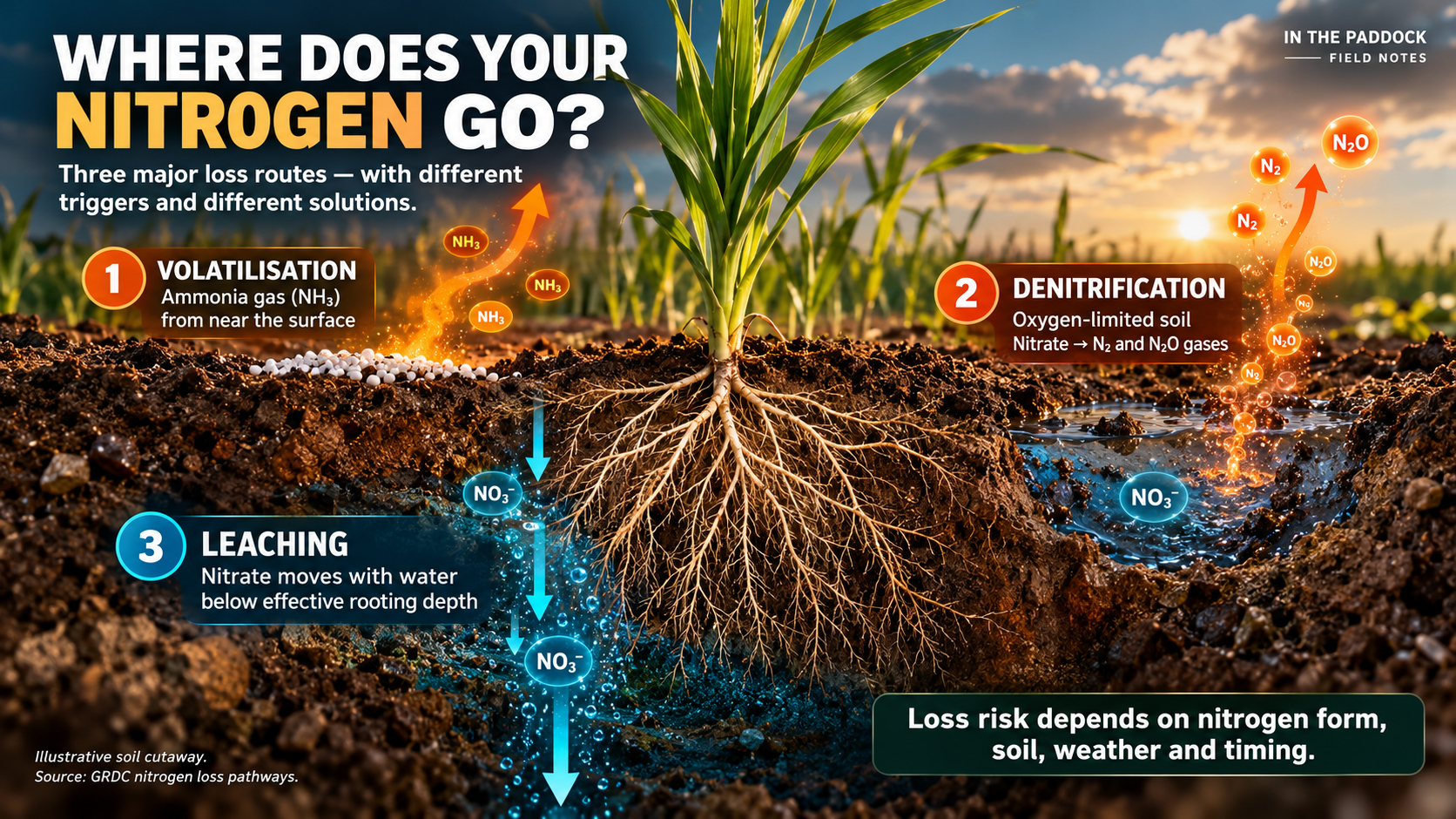
Ammonia volatilisation: nitrogen escapes as NH₃ gas, particularly when urea hydrolyses near the surface. It is a different process from nitrous oxide production.
Leaching: nitrate moves with drainage water beyond the crop’s effective rooting depth. Nitrate moving down within a root-accessible profile is not automatically lost to that crop.
Denitrification: oxygen-limited conditions allow microbes to convert nitrate into gaseous forms, including N₂O and N₂. Wetness, available nitrate and microbial activity interact; a wet paddock does not imply a fixed percentage loss.
Other pathways: runoff can carry nitrogen away, and nitrification itself can generate nitrous oxide. Bell, Schwenke and Grace’s 2025 GRDC review emphasises that soil, season and fertiliser management determine which pathway dominates.
Also separate loss from temporary unavailability. Nitrogen retained in soil or immobilised in microbes has not necessarily left the system. A crop recovering only part of this season’s fertiliser does not mean the remainder has all escaped.
How does the plant actually capture nitrogen?
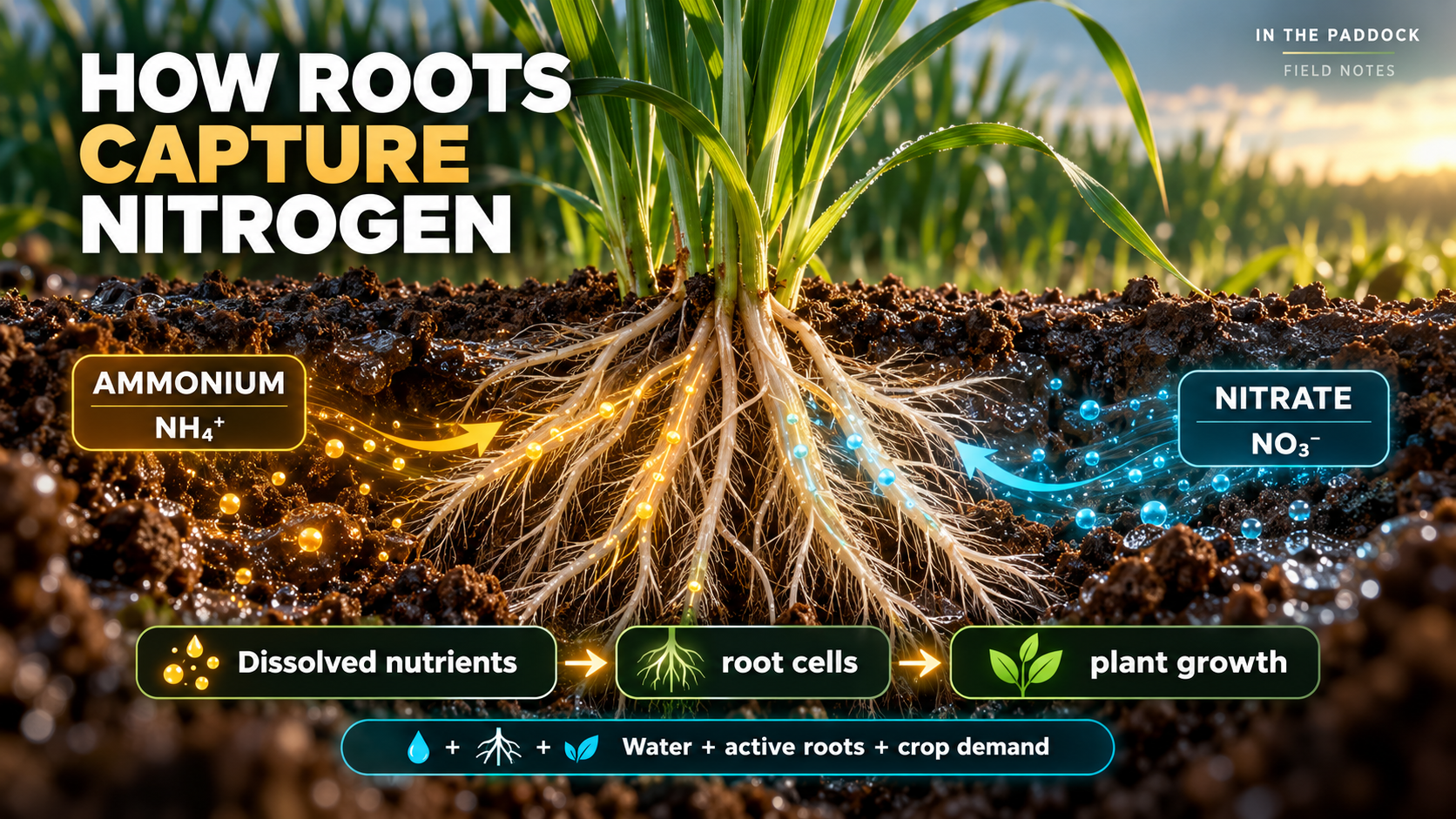
Ammonium’s positive charge allows it to associate with soil exchange sites, generally making it less mobile than nitrate. Roots take up nitrogen from the soil solution through transport systems in root cells. Nitrate moves readily with water; diffusion and root exploration also help bring nutrients and roots together.
Inside the plant, absorbed nitrate is reduced before its nitrogen is incorporated into amino acids. Ammonium also feeds into amino-acid synthesis. These compounds underpin proteins, enzymes and growth. The GRDC Nitrogen Reference Manual explains uptake and assimilation in detail.
Keeping nitrogen in the paddock is therefore only part of the job. It must be in a reachable position when roots are active and crop demand is strong. Dry soil, poor rooting or poorly timed supply can leave retained nitrogen unavailable when the crop needs it.
Urease inhibitors: buying time near the surface
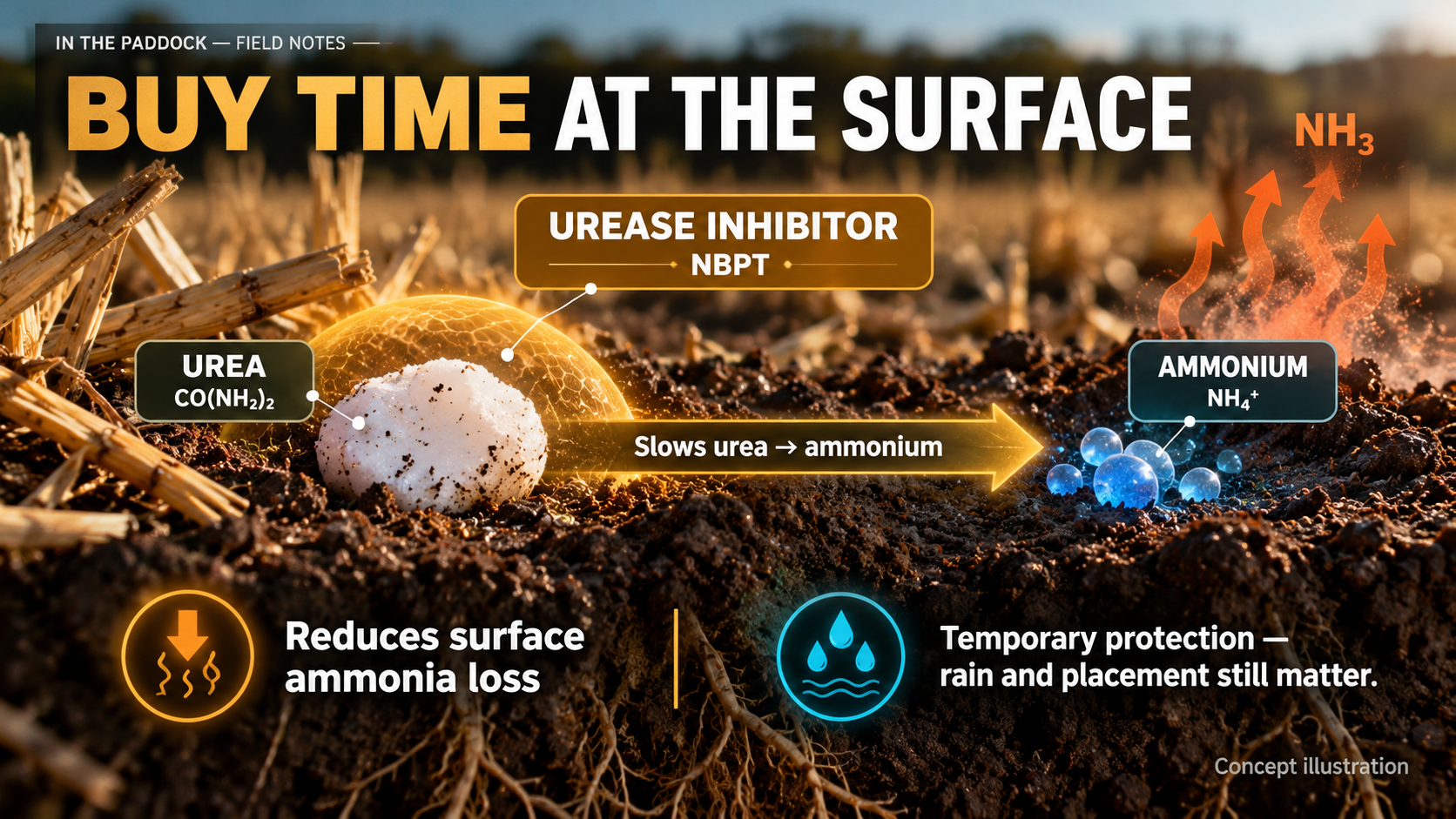
A urease inhibitor such as NBPT delays enzyme-driven urea breakdown. Its main practical role is to reduce the burst of ammonia loss while surface-applied fertiliser waits for effective incorporation by rain, irrigation or cultivation. It does not permanently lock nitrogen away.
The protection window varies with conditions, including temperature, moisture and soil properties. A light wetting can dissolve urea without carrying it sufficiently into the soil; a universal rainfall threshold is therefore a poor substitute for assessing the actual situation. The published review of NBPT performance discusses why timing and incorporation remain central.
There is another important wrinkle: preserving nitrogen as urea does not make it immobile. GRDC-supported research on banded fertilisers found that delaying hydrolysis changed nitrogen movement, with preserved urea capable of moving deeper. That may help access in one situation and increase loss risk in another.
Nitrification inhibitors: holding nitrogen as ammonium
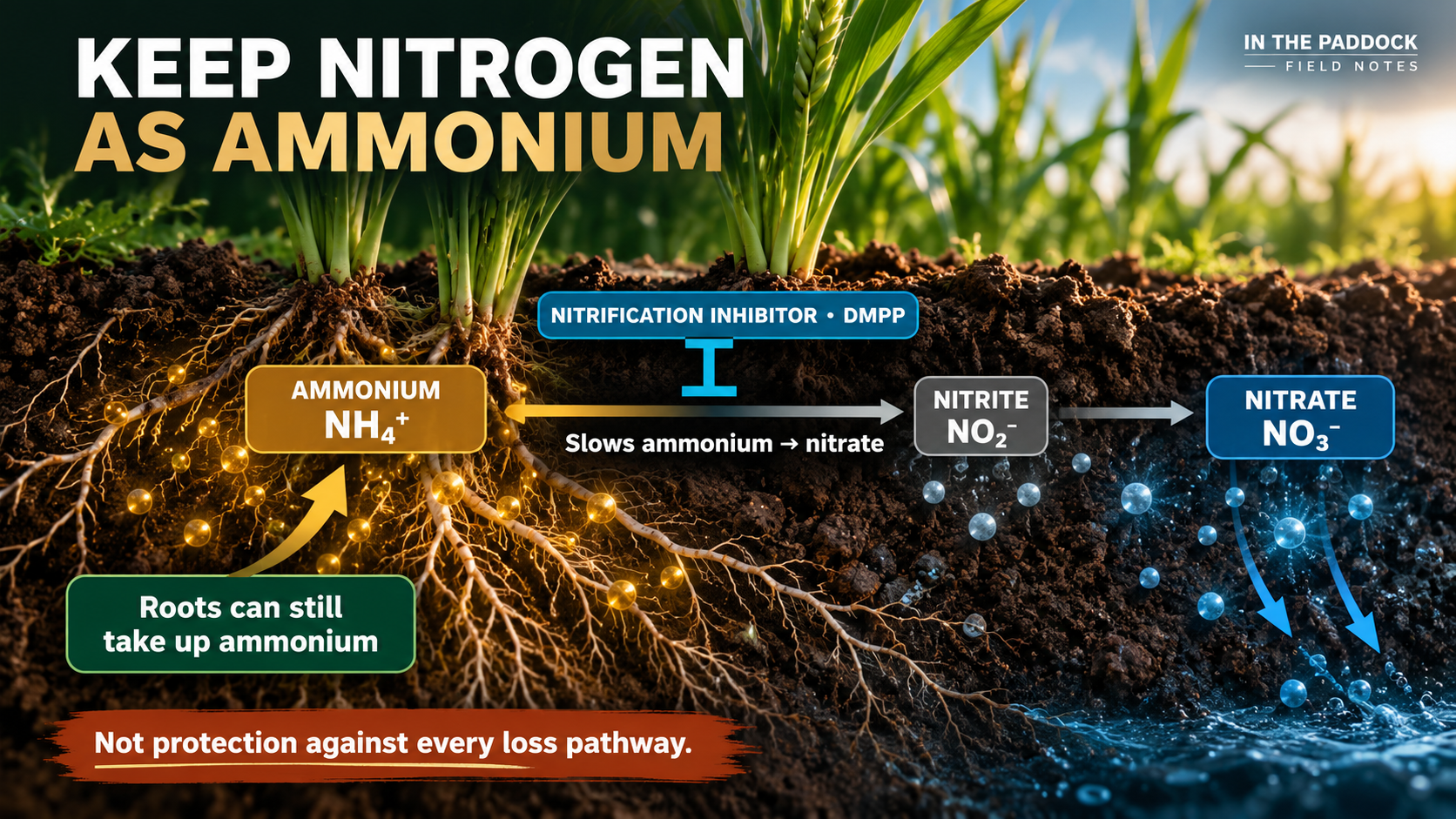
Nitrification inhibitors such as DMPP slow microbial oxidation of ammonium. The aim is to retain more nitrogen in the ammonium pool for longer, reducing its exposure to later nitrate-related losses. Roots can still use that ammonium.
These products act downstream of urea hydrolysis. They do not provide equivalent protection against an earlier surface-ammonia loss. Their performance also depends on whether the inhibitor and the nitrogen remain together in the relevant soil zone. The banding research shows why soil permeability, movement and placement can change the outcome.
The commercial test is broader than a reduction in one gas. The 2025 GRDC review cautions that changes in particular loss pathways have not consistently translated into improved crop fertiliser-N recovery. Measure the crop and the nitrogen balance, as well as emissions.
Urease, nitrification and BNI: the differences at a glance
| Approach | Stage affected | What to expect |
|---|---|---|
| Urease inhibitor, e.g. NBPT | Urea hydrolysis | Temporary reduction in surface ammonia-loss risk; incorporation still matters. |
| Nitrification inhibitor, e.g. DMPP | Ammonium oxidation towards nitrate | Slower nitrate formation; benefit depends on soil conditions and loss risk. |
| Biological nitrification inhibition | Nitrification around roots | Plant-produced compounds; breeding and local agronomic performance remain research questions. |
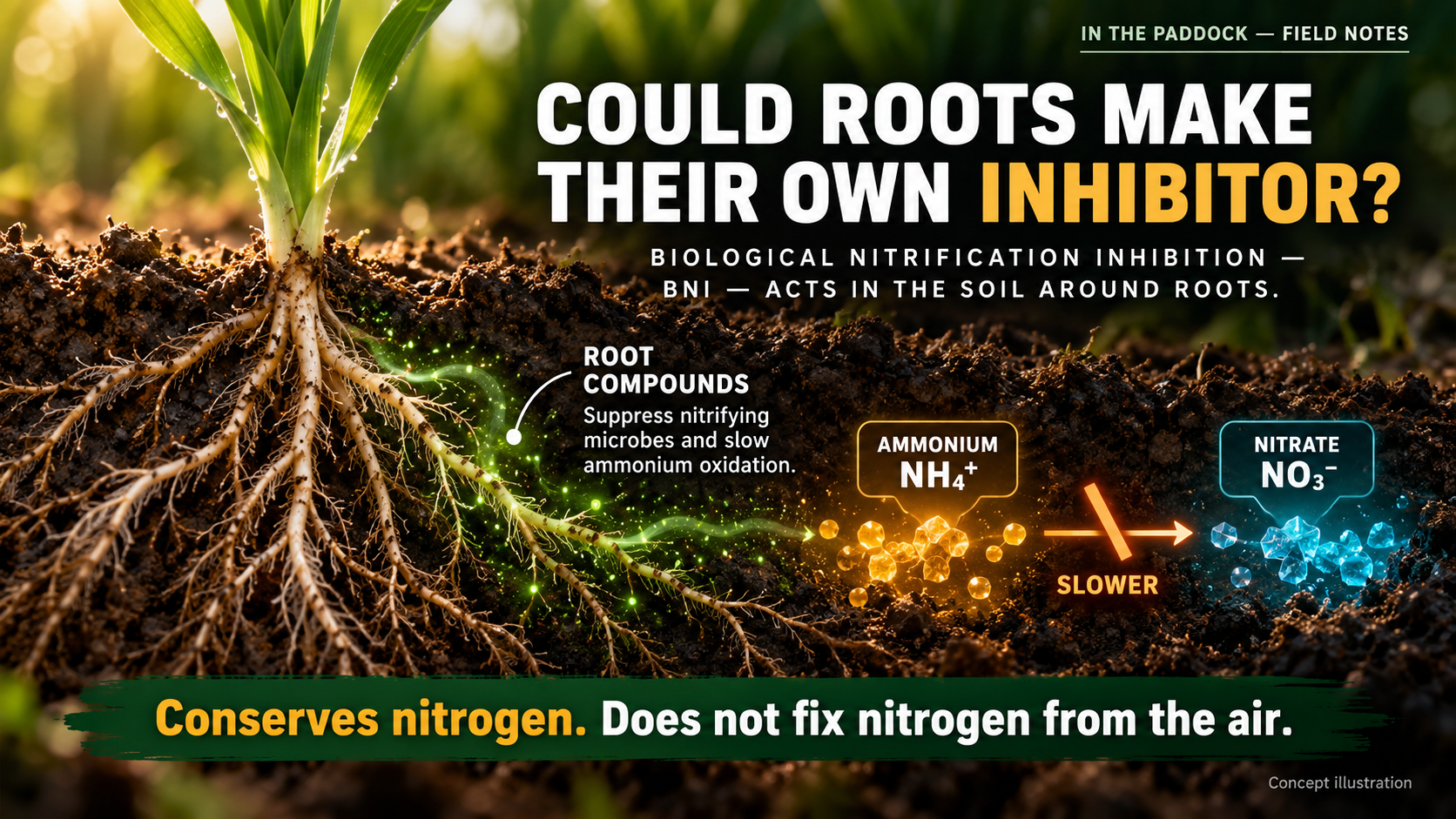
A terminology point: the term here is nitrification inhibitor. Nitrogenase is associated with biological nitrogen fixation—the conversion of atmospheric nitrogen into a biologically usable form. BNI conserves nitrogen already in the system; it does not give wheat the ability to manufacture its nitrogen supply from the air.
Could the crop produce its own inhibitor?
Some plants release compounds through their roots that suppress nitrification in the surrounding soil, or rhizosphere. Breeding for stronger BNI could make nitrogen conservation a more useful varietal trait. The CSIRO explanation sets out this plant–soil mechanism.
The distinction is location and timing. A root-mediated effect depends on roots and their compounds reaching the relevant nitrogen. It should not be treated as an automatic replacement for protection of freshly broadcast urea, or assumed to protect an entire fallow before the crop is established.
What Australia is investigating
On 23 July 2026, GRDC announced a four-year, $10 million investment led by CSIRO, focusing on wheat, sorghum and canola. Partners include the University of Queensland, Australian Grain Technologies, InterGrain and the Australian National University.
Researchers will examine variation in BNI capacity and interactions with soils, climate and management, with modelling including APSIM NextGen to explore potential outcomes. This is foundational research towards future options—not an announcement of a commercial variety or a proven fertiliser-rate reduction. Read the GRDC GroundCover announcement and CSIRO release.
Promising overseas results—with the qualification attached
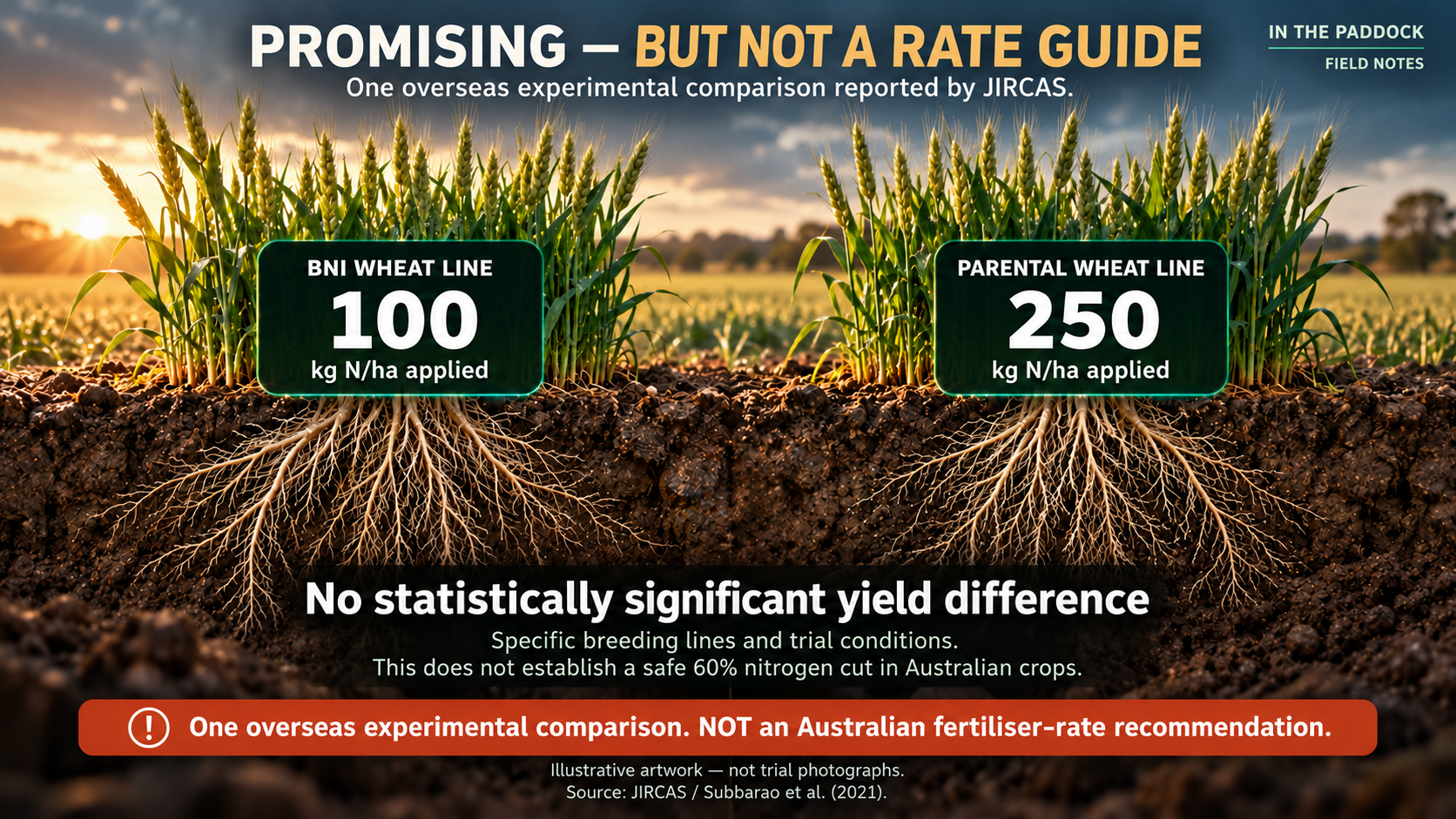
Researchers introduced BNI capacity from the wild wheat relative Leymus racemosus into wheat breeding material. JIRCAS’s 2021 research summary reports that experimental BNI-Munal had around two to five times its parental line’s BNI capacity.
In one comparison, BNI-Munal receiving 100 kg N/ha had no statistically significant yield difference from its parental control receiving 250 kg N/ha. That is a valuable proof of potential. It does not establish that Australian growers can safely cut nitrogen rates by 60%, nor that the result will persist across varieties, soils and seasons.
A 2022 study by Bozal-Leorri and colleagues found reductions in ammonia-oxidising bacterial abundance of 60% and 45% in two BNI wheat lines. However, grain yields under the high-nitrogen field treatment were similar to their controls. A measurable biological effect and a profitable yield response are separate tests.
What would make BNI valuable in Australian paddocks?
My assessment is that the next useful evidence needs to answer five buying questions.
1. Which loss is it preventing? I would want evidence that nitrate-related losses materially constrain the target system. A benefit against one pathway is less persuasive if another pathway dominates.
2. Does protection coincide with the risk? Trial design should examine sowing date, root development, fertiliser placement and rainfall timing. The difficult question is whether protection is operating before a major loss event, not just whether roots can release an inhibitor.
3. Does the variety remain competitive? Yield, maturity, disease resistance, lodging and grain quality still matter. A useful nitrogen trait has to sit inside a variety growers would otherwise be willing to sow.
4. Does it work across seasons? For northern grain systems, I would want wet-season and dry-season comparisons, including crops using stored soil moisture. Those are proposed evaluation priorities—not demonstrated regional benefits.
5. Does the benefit survive a full budget? Trials should distinguish equal-N yield gains from savings at equal yield and quality. Both can matter, but they need different calculations. Seed premiums, changed application costs and grain-quality effects belong in the same assessment.
A simple way to test the economics
Here is a hypothetical example, not a product quote or BNI forecast. Suppose a treatment adds $20/ha and genuinely lets a grower buy 10 kg N/ha less while maintaining yield and quality. At an assumed $2/kg N, the fertiliser saving is $20/ha: it only covers the treatment cost before any other changes.
If the same treatment instead raises yield by 0.1 t/ha at an assumed grain price of $300/t, that is $30/ha extra gross revenue, or $10/ha after the $20 treatment premium and before extra harvest, freight or other costs. Do not add both benefits unless the trial demonstrates them occurring together.
This is why a striking nitrogen-loss percentage is not enough for a purchase decision. Ask for replicated comparisons, the full nitrogen rates, grain protein or quality, and the range of responses—not just the best site.
The Field Notes verdict: watch this space
BNI deserves attention because it could broaden what we ask plant breeding to deliver. The appeal is a variety that helps protect the nitrogen investment while maintaining the agronomics growers need. The Australian programme is an opportunity to establish where that promise holds.
For now, the practical lesson is to match nitrogen management to the actual pathway at risk. Keep product, rate, timing and placement together. Do not reduce a nitrogen budget on the strength of one overseas comparison or a research announcement.
What would persuade you to choose a nitrogen-protecting variety: lower fertiliser costs, more reliable yield, or stronger performance in wet seasons? Share your view in the comments.
Sources and further reading
CSIRO: Australian BNI research investment, 23 July 2026
GRDC GroundCover: future crop options
Bell, Schwenke & Grace: nitrogen loss pathways and mitigation (2025, PDF)
GRDC: Nitrogen Reference Manual (2020, PDF)
University of Minnesota Extension: fertiliser urea chemistry
Cantarella and colleagues: review of NBPT as a urease inhibitor (2018)
Janke and colleagues: stabilised and controlled-release nitrogen (2020, PDF)
JIRCAS: BNI-enabled wheat results (2021)
Bozal-Leorri and colleagues: BNI traits in wheat (2022)
Research checked 12 October 2026. Graphics are AI-generated explanatory illustrations prepared for In The Paddock — Field Notes; they are not photographs of research trials.

