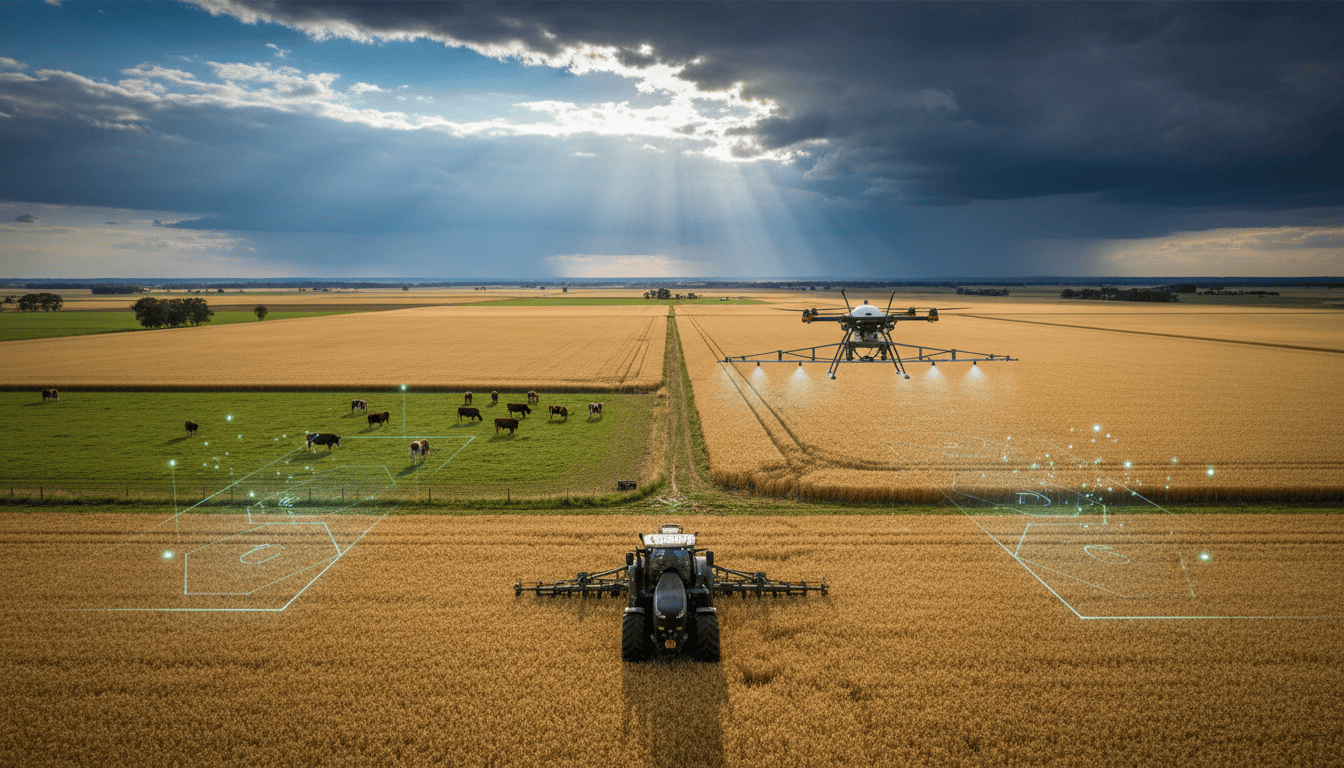
A chatbot that interprets a soil test. A camera that decides which weed to spray. A robot that works while its operator sleeps. An algorithm that predicts how much feed is in the paddock. Artificial intelligence is no longer simply a futuristic idea for agriculture — parts of it are working on Australian farms today.
That creates an uncomfortable question for me. As both a farmer and a practising agronomist, I rely on my knowledge and experience to make decisions. But if a computer can analyse the same information in seconds, will AI make me a better agronomist — or eventually put me out of a job?
The answer is more interesting than either the utopian sales pitch or the doom-laden headlines. Some applications are already delivering genuine benefits. Others are prototypes, and some are perfectly capable of producing beautifully written but dangerously wrong advice. Here is where the technology stands in October 2026, and what it means in the paddock.
First, not everything digital is AI
We often lump a GPS steering system, a drone, a crop-growth model and ChatGPT into one category. They are not the same. Automation carries out a task; machine learning looks for patterns; computer vision interprets images; and generative AI produces language, code and other content. A modern agricultural machine may use several of these at once.
| Technology | What it actually does | Practical agricultural use |
|---|---|---|
| Computer vision | Recognises objects or patterns in images | Detecting weeds, crop stress and animal behaviour |
| Predictive models | Estimates likely outcomes from data | Yield, disease risk, weather-related decisions |
| Autonomy and robotics | Carries out physical work with minimal intervention | Spot spraying, weeding, grazing systems |
| Generative AI | Explains, summarises and synthesises information | Comparing agronomic options, analysing reports, drafting plans |
This distinction matters when evaluating claims. An automated virtual fence, for example, is not automatically evidence that a generative AI model can safely recommend herbicides.
1. Australia is already putting AI to work
Autonomous machinery: Queensland-built SwarmFarm
Australia is not starting from scratch. Queensland company SwarmFarm Robotics has commercial autonomous vehicles operating in Australian broadacre systems. Its customer examples include two SwarmBots reported to have covered nearly 40,000 hectares in a year in the NSW Riverina, undertaking spraying work without an operator sitting in the cab. Another grower describes moving a robot between farms and paddocks to work after dark.
For farmers facing labour shortages, that is an obvious attraction. A robot does not eliminate the need for people: someone still maps boundaries, monitors the machine, manages chemical mixes, maintains equipment and decides whether the job should be done. But it changes what farm labour looks like. Those operating figures are grower stories published by the supplier, not independent performance benchmarks.
Weed recognition and drone spraying: trials in Australian cotton
A CQUniversity field project reported in February 2025 used drones to gather high-resolution photographs of cotton crops, local AI image processing to identify weeds, and GPS coordinates sent to spraying drones for targeted treatment. An important feature was that imagery could be processed locally instead of requiring constant cloud uploads.
That is especially relevant in Australia, where internet coverage, bandwidth and the expense of moving huge image files can be real impediments. It is a successful prototype trial, however — not evidence that every crop, weed species or commercial spraying situation has been solved.
Sugarcane disease detection: an Australian AI prototype
In March 2026, the Australian Government’s Australia’s Economic Accelerator program profiled Sugar-AI, developed at James Cook University with industry partners. It uses freely available satellite imagery and machine learning to generate paddock-scale risk maps for ratoon stunting disease in sugarcane.
That is a useful distinction: a risk map tells a grower where to investigate, not that a laboratory diagnosis can be skipped. The technology was described as a working prototype. Used well, it may make disease surveillance more targeted; used uncritically, a false positive or missed infection could send a grower down the wrong path.
AI agronomy and digital twins: canola, grapes and crop models
Adelaide University research published in February 2026 explored AI-enabled digital twins and decision support with South Australian vineyards and Victorian canola growers. Meanwhile, CSIRO’s Trusted AI Agronomist research uses a neural network to approximate outputs of the APSIM crop model and explicitly considers the uncertainty around forecasts.
That final detail is critical. Good decision support should not just say a crop will yield 5 tonnes per hectare; it should help explain under what assumptions, and how much the result could vary. CSIRO is exploring the potential for this sort of support rather than presenting an autonomous agronomist ready to take legal responsibility for a paddock.
2. What is already happening overseas?
John Deere: the case for targeted spraying
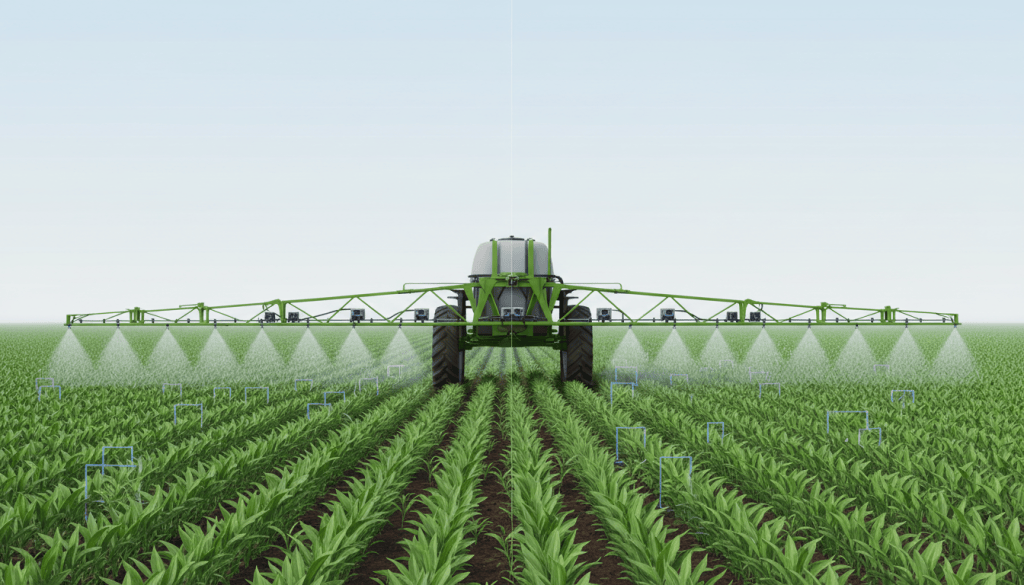
The most concrete commercial example is machine-vision spot spraying. In November 2025, John Deere reported that See & Spray was used on more than five million US acres in the 2025 season. Deere said customers used nearly 50% less non-residual herbicide on average, with almost 31 million US gallons of spray mixture avoided across those operations.
The caveats matter: these are manufacturer-reported numbers, the percentage is for particular non-residual herbicide uses, the acreage is not necessarily directly comparable with Australian broadacre cropping, and the gallons refer to herbicide mixture, not neat active ingredient.
What did targeted spraying save?
Illustrative index of non-residual herbicide use, using Deere’s reported nearly 50% average reduction in 2025
Source: John Deere, 4 November 2025. This index illustrates the reported relative reduction; it is not a claim of 50% lower total spray cost or 50% less concentrate in every application.
LaserWeeder: killing weeds with light
US company Carbon Robotics has commercial equipment that uses cameras and AI recognition to direct lasers at weeds. Its published customer roster includes growers in Australia as well as North America and Europe. Rather than spraying a weed, the system attempts to destroy its growing point with a precisely directed laser.
It is particularly interesting for high-value horticultural crops where hand weeding is costly. But the economic equation for slow, high-precision weeding of vegetables differs enormously from covering thousands of hectares of broadacre cereals. Speed, capital cost, crop spacing and weed pressure decide whether the technology stacks up; the manufacturer’s productivity figures should not be read as independently verified across all settings.
3. AI for livestock: the fence is becoming software
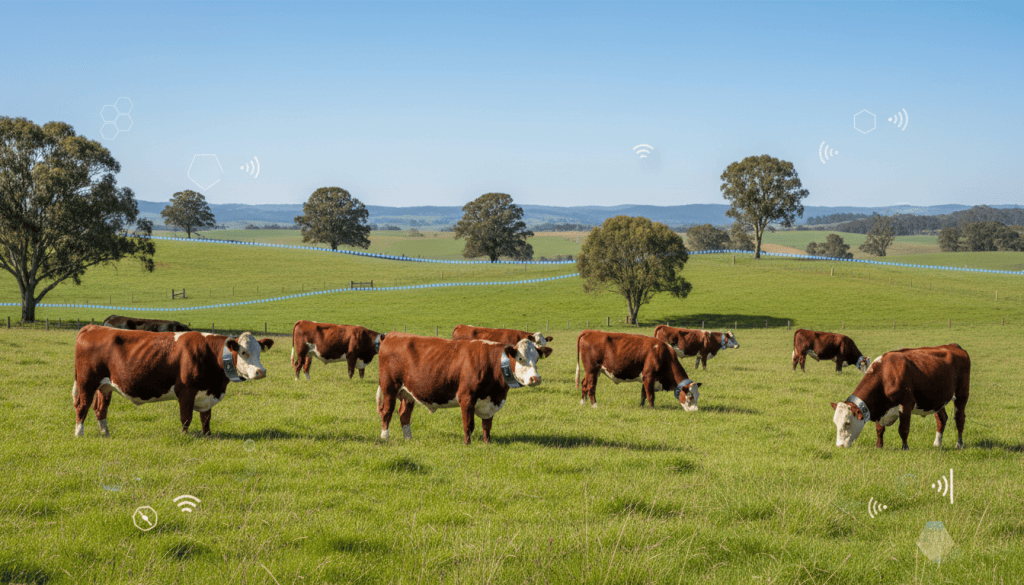
The opportunity extends beyond grain. GPS-enabled virtual fencing systems can let producers draw grazing boundaries on a screen and guide trained cattle using audio and other prescribed cues. Dairy Australia reported in January 2026 approximately 200,000 cattle using Halter in New Zealand and about 20,000 in Tasmania.
Research at the Tasmanian Institute of Agriculture has tested automated pasture allocation and movement to milking. Virtual fencing relies on sensors, location data and automated behavioural systems; it is part of the broader digital farming story, even where particular functions are not best described as generative AI.
Regulation and welfare remain central. NSW permits regulated virtual fencing of cattle with safeguards, including training and monitoring requirements. It is not a replacement for the external property boundary fence.
4. Could ChatGPT actually run a paddock?
This is where I find the technology most exciting — and most dangerous to overestimate. I have been using AI as a thinking and analysis tool around cropping programs, soil tests, machinery choices, drone and spatial data, and livestock performance. It is very good at structuring messy information, identifying missing numbers, setting out options and checking arithmetic. It is not a substitute for inspecting the crop, understanding the history of a paddock or knowing the latest registered chemical directions.
Consider the job of preparing a wheat program. An AI assistant can read soil-test results, calculate nutrient removal under an assumed yield, compare fertiliser costs, organise a seasonal operations calendar, and highlight uncertainties. With reliable live connections it might integrate weather, paddock maps, scouting notes and machinery records. But a high-stakes recommendation still depends on weed identification, resistance, crop stage, water availability, local trials, chemical registrations and the quality of the inputs.
AI is at its best as a second set of eyes and a fast research assistant — not as the person who signs off an irreversible paddock decision.
What a useful AI-assisted decision should look like
- 1. Gather the facts: verified soil tests, actual paddock history, scouting records, local weather and crop stage.
- 2. Specify the question: what decision are we trying to improve — gross margin, disease risk, nitrogen response or labour?
- 3. Show the workings: assumptions, units, calculations, references and expected variation, not just a confident recommendation.
- 4. Verify independently: current product labels and permits, local trials, reliable weather data and professional advice.
- 5. Trial and measure: retain an untreated or standard-practice comparison where sensible; keep records of yield, cost and operational outcomes.
5. Could the economics stack up?
A technology is only useful to a farming business if the benefits exceed the costs and risks. Headline herbicide reductions are attractive, but equipment price, depreciation, software charges, setup, staff time, maintenance, extra passes, missed weeds and resistance management all matter.
Here is a hypothetical calculation, not a field-trial result. Assume 2,000 hectares, and an eligible non-residual herbicide cost of $18 per hectare under a blanket program. The baseline chemical spend is $36,000. If precision application reduced just that particular herbicide component by different amounts, gross chemical savings would be:
| Reduction in eligible herbicide component | Gross saving across 2,000 ha | Important qualification |
|---|---|---|
| 25% | $9,000 | Before equipment, software, fuel, labour and retreatment costs |
| 50% | $18,000 | Illustrative mid-case, not a guaranteed field result |
| 70% | $25,200 | High saving only where weed distribution and system performance support it |
The calculation is 2,000 ha × $18/ha × percentage reduction. It does not assume total program costs fall by the same percentage. A $20,000 annual equipment-and-software cost would eliminate the mid-case gross saving before allowing for any other benefits or expenses. This is why an independent gross-margin comparison is more informative than a brochure percentage.
6. The risks we should be discussing more openly
Hallucinations, wrong sources and false precision
Generative AI can produce a plausible answer even when a fact is missing. A model might invent a trial, mix up units, recommend a chemical that is not registered for the situation, or overlook a resistance issue. The APVMA makes clear that users must consult approved label instructions; an AI-generated plan is not a pesticide label or permit. State-specific off-label rules also matter.
Farm data, privacy and control
If an AI platform holds your soil tests, paddock boundaries, yield maps, chemical purchases, livestock records and costs, it may know an extraordinary amount about your business. Who can access that information? Can it be exported? Is it used to train models? What happens when a provider disappears or changes its terms?
The National Farmers’ Federation’s Australian Farm Data Code provides a useful framework for assessing how digital service providers collect, use and share farm data. Producers should read the agreement rather than assuming that paying for a service means they control everything generated from their information.
Bias, connectivity, liability and animal welfare
A model trained in North American maize may not perform well in an Australian wheat and chickpea rotation. A cloud-dependent service may be unavailable during the crucial spraying window. A misidentified weed may receive no treatment; a false positive may trigger crop damage. A virtual livestock boundary must be operated within animal welfare safeguards. And when advice causes a loss, it must be clear who made and authorised the final decision.
7. So, will AI take my job as an agronomist?
Some of the routine work is plainly vulnerable: collating field notes, assembling reports, calculating simple rates, searching information and preparing first-draft plans. There is no point pretending otherwise. In February 2026, DataFarming’s Tim Neale argued at a GRDC Grains Research Update that these technologies would help agronomists work more effectively rather than simply replacing them, according to Grain Central’s report.
My expectation is that the value of an agronomist will shift towards interpretation, ground-truthing, risk management, relationships and accountability. A good adviser who can use AI intelligently may cover information faster and spend more time on the decisions that matter. An adviser who ignores the technology altogether may find themselves competing against people who are substantially more efficient.
But I do not believe farming becomes simple just because the computer can explain it. The paddock will always have surprises: uneven rainfall, soil variability, resistant weeds, machinery constraints, mixed enterprises and economic decisions that depend on a farmer’s appetite for risk.
8. Five practical ways to start using AI on your farm
- Analyse, don’t delegate: ask AI to compare the costs and assumptions behind two existing agronomic strategies.
- Use it for administration: turn scouting notes into structured reports, meeting summaries and operation checklists.
- Look for measurable problems: a repeated labour-intensive task or costly input is a better starting point than buying technology for its own sake.
- Keep your own records: store inputs, outputs and the human decision behind each recommendation. Never rely on AI for current chemical labels.
- Run a controlled comparison: measure cost per hectare, agronomic outcome, time saved and unexpected costs over a full season.
The bottom line
The agricultural industry should neither fear AI blindly nor buy into every promise. Machine vision and autonomous machinery are already producing real commercial outcomes. AI-enhanced crop forecasting, disease mapping and agronomic assistants are advancing, but their reliability varies by use case. The next few years will be less about whether farmers can access artificial intelligence and more about whether we can integrate it into profitable, accountable decision-making.
I want AI to make me a better farmer and a better agronomist. But the responsibility for what happens in the paddock cannot be outsourced to a convincing paragraph on a screen.
What do you think? Would you trust AI to recommend your next fertiliser program or crop-protection decision? Do you think it will replace parts of the agronomist’s role? Share your experiences in the comments.
Watch or listen: this article accompanies the In The Paddock YouTube channel and podcast episode, AI in Agriculture: Will It Make Us Better Farmers or Replace Us?
References and further reading
- CSIRO (2025): How AI is reshaping agriculture — AI agronomy, uncertainty, remote sensing and responsible adoption.
- SwarmFarm: Australian grower case studies — manufacturer-published commercial operating examples.
- CQUniversity (2025): AI weed-targeting drone trials — cotton field prototype.
- Australian Government (2026): Sugar-AI — prototype disease risk mapping in sugarcane.
- Adelaide University (2026): Digital twins in vineyards and canola.
- John Deere (2025): See & Spray commercial results — manufacturer-reported acreage and chemical savings.
- Carbon Robotics: Commercial LaserWeeder — manufacturer product overview.
- Dairy Australia (2026): Virtual fencing adoption.
- University of Tasmania: Evaluation of virtual fencing and herding.
- NSW Government: Virtual fencing regulatory safeguards.
- APVMA: Understanding pesticide labels.
- National Farmers’ Federation: Australian Farm Data Code.
- Grain Central (2026): AI and the role of the agronomist.
Research cut-off: 25 October 2026. Product results quoted above are attributed to the original organisations and should not be treated as universal farm performance guarantees. Generated illustrations depict concepts rather than specific trial machinery.

